Cash vs accruals: HMRC guide for UK sole traders

Most UK sole traders will find the cash basis simpler and more practical for Self Assessment. Since the 2024/25 reforms, the cash basis is now the default for most unincorporated businesses, meaning you use it automatically unless you elect otherwise. Accruals, known formally as traditional accounting, remains the better choice when your business holds significant stock, operates on credit terms, or needs accounts that satisfy a lender.
Before going further, check your position against these three decision points:
- Choose cash basis if your income arrives and your bills are paid in roughly the same tax year, you hold little or no stock, and you want the simplest possible Self Assessment return.
- Choose accruals if you invoice customers on credit, carry stock or work-in-progress, or need accounts that show a lender or investor an accurate picture of profit.
- Check GOV.UK eligibility first at Gov before changing basis, and calculate any transitional adjustments before you file.
Key takeaways
The cash basis is now the default for most UK sole traders, but the right choice depends on your business model, not just your eligibility.
| Point | Details |
|---|---|
| Cash basis is the default | Since 2024/25, most unincorporated businesses use cash basis unless they elect otherwise. |
| Accruals suits credit and stock businesses | If you hold stock, sell on credit, or need lender-grade accounts, accruals gives a more accurate result. |
| Switching triggers adjustments | Moving between bases requires transitional adjustments for debtors, creditors, stock, and capital allowances. |
| MTD requires compatible software | From April 2026, quarterly digital submissions are required; your software must handle your chosen basis correctly. |
| Ledgery supports MTD compliance | Ledgery captures receipts, generates quarterly reports, and exports records for either accounting basis. |
Table of Contents
- What is the cash basis and how does HMRC treat income and expenses?
- Who can use the cash basis and who must use accruals?
- What is traditional (accruals) accounting and when is it the better choice?
- How do the two methods compare across key practical dimensions?
- How do you decide which basis is right for your business?
- How do you switch between bases and what adjustments should you expect?
- Worked examples: the same transactions under each basis
- Record-keeping, Making Tax Digital, and staying compliant
- The cash vs accruals decision deserves more thought than most sole traders give it
- Ledgery makes record-keeping straightforward for either basis
- Sources
What is the cash basis and how does HMRC treat income and expenses?
The cash basis is a straightforward method: you record income when money is actually received and expenses when they are actually paid. There are no debtors, creditors, stock valuations, or work-in-progress figures to calculate. HMRC’s Business Income Manual confirms that the cash basis removes the need for most balance-sheet items, making taxable profit a direct function of receipts and payments.
Under the cash basis, most equipment costs can be deducted immediately as an allowable expense. Cars are the main exception: they still follow capital allowances rules regardless of which basis you use. HS222 sets out the full list of expense categories and how each is treated differently between the two bases.
Common receipts and payments under the cash basis look like this:
- A client pays an invoice on 10 April 2025: that amount is income in the 2025/26 tax year, even if the invoice was raised in March 2025.
- You buy a laptop for £800 on 3 March 2026: the full £800 is an allowable expense in 2025/26, with no need to spread it over the asset’s useful life.
- A supplier invoice dated 28 March 2026 is paid on 5 April 2026: the expense falls in 2025/26 because the payment date governs.
Pro Tip: HMRC allows you to choose whether to use the card transaction date, the bank statement entry date, or another consistent date as your “received” or “paid” date, provided you apply the same rule throughout your records. Mixing approaches within a year can create discrepancies that are difficult to explain in a compliance check.
Who can use the cash basis and who must use accruals?
Eligibility for the cash basis is broad but not universal. GOV.UK sets out the full eligibility rules, and the list of exclusions is worth checking before you assume you qualify.
Businesses that can use the cash basis:
- Sole traders with any level of turnover (the previous turnover cap was removed in 2024/25).
- Ordinary partnerships that do not have a corporate partner.
- Businesses with multiple trades, where you can elect to use different bases for each trade separately.
Businesses that cannot use the cash basis and must use accruals:
- Limited companies and limited liability partnerships (LLPs).
- Partnerships with a corporate partner.
- Certain specialist trades listed by HMRC, including Lloyd’s underwriters and some farming and creative businesses with specific averaging claims.
- Businesses that have claimed certain reliefs that are incompatible with the cash basis.
If you are unsure whether your trade falls into an excluded category, check the current GOV.UK list before filing. The rules have changed in recent years, and relying on older guidance risks an incorrect return.
What is traditional (accruals) accounting and when is it the better choice?
Traditional accounting, or the accruals basis, records income when it is earned and expenses when they are incurred, regardless of when cash actually moves. A sale invoiced on 28 March 2026 is income in 2025/26 even if the customer pays in May 2026. A supplier bill received in March 2026 is an expense in 2025/26 even if you pay it in April.
This approach requires you to maintain debtors and creditors lists, value stock and work-in-progress at year-end, and account for prepayments and accruals. The administrative load is higher, but the resulting profit figure more accurately reflects what the business earned in a given period.
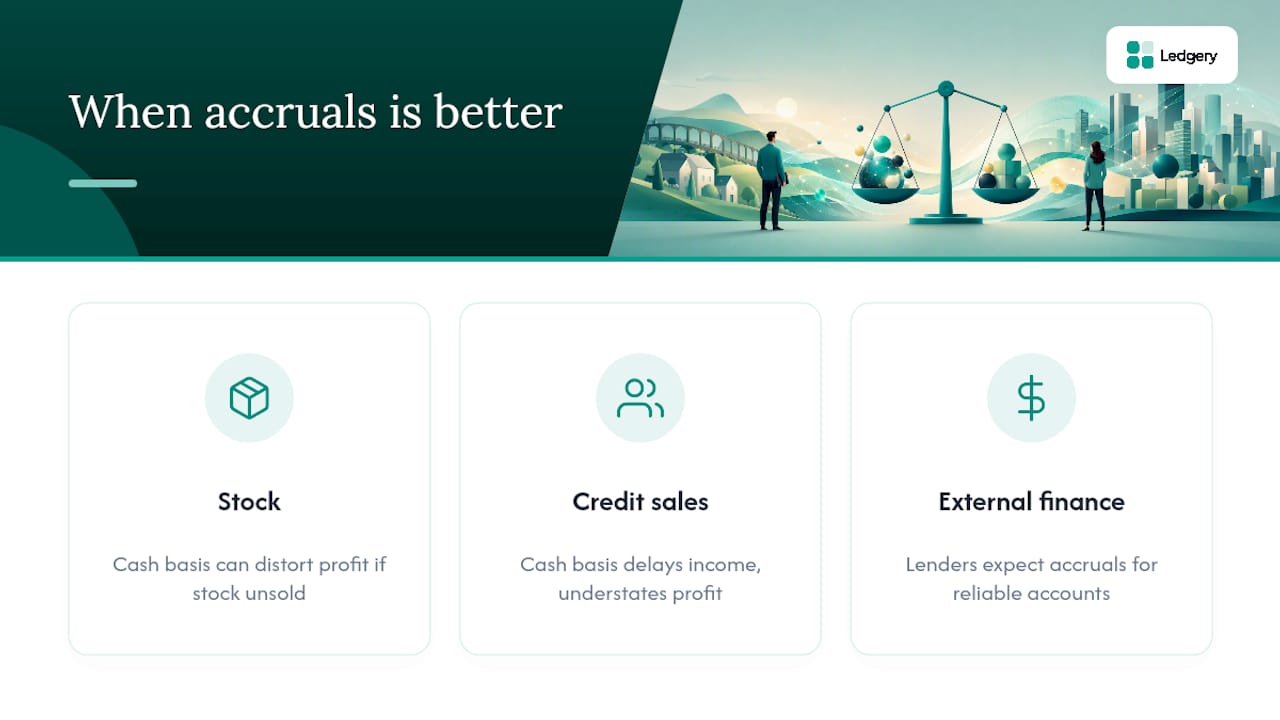
Accruals accounting tends to be the better fit in three situations. First, if you carry significant stock, the cash basis can distort profit by treating the full cost of goods as an expense in the year of purchase, even when much of that stock remains unsold. Second, if you sell on credit, the cash basis delays income recognition until payment arrives, which can understate profit in a growing business and cause problems if a lender or investor reviews your accounts. Third, if you need external finance, most banks and commercial lenders expect accounts prepared on the accruals basis because it gives a more reliable view of profitability and net assets.
Pro Tip: Even if you use the cash basis for your Self Assessment return, consider asking your accountant to prepare a separate set of accruals-based management accounts. Many advisers do this routinely because the cash basis alone can mask trends in debtor ageing, stock build-up, and true profitability.
How do the two methods compare across key practical dimensions?
The table below covers the dimensions that most directly affect tax timing and day-to-day administration.
| Dimension | Cash basis | Accruals (traditional) |
|---|---|---|
| Simplicity / admin burden | Low: no debtors, creditors or stock values needed | Higher: requires year-end adjustments, balance sheet items |
| Tax timing and cash-flow | Tax follows cash receipts, so you pay tax on money you have actually received | Tax can fall due on invoiced income not yet collected |
| Stock and credit sales | Not well suited: stock costs deducted when paid, sales taxed when received | Better match: stock and debtors align income with the period earned |
| VAT treatment | VAT rules are separate; cash basis does not alter VAT obligations | Same: VAT is governed by VAT registration rules, not the accounting basis |
| Capital allowances | Most equipment deducted immediately; cars still use capital allowances | All capital assets go through capital allowances or depreciation |
| Eligibility | Sole traders and qualifying partnerships; companies and LLPs excluded | Available to all business types; required for excluded businesses |
| Switching adjustments | Moving to accruals triggers one-off transitional adjustments | Moving to cash basis also triggers adjustments; spreading rules apply |
VAT is worth a brief note. The VAT cash accounting scheme is a separate election that lets VAT-registered businesses account for VAT on receipts and payments rather than invoices. It operates independently of whether you use the cash basis or accruals for income tax. You can be on the VAT cash accounting scheme while using accruals for income tax, or vice versa.
The practical verdict by dimension: for sole traders with straightforward income and no significant stock, the cash basis wins on simplicity and tax timing. For businesses with credit customers, stock, or financing needs, accruals gives a more accurate and lender-friendly result.
How do you decide which basis is right for your business?
Work through these questions in order. Your answers will point clearly to one basis or the other.
- Do you hold stock or work-in-progress at year-end? If yes, accruals will give a more accurate profit figure and is usually the better choice.
- Do you sell on credit terms? If customers regularly pay 30, 60, or 90 days after invoicing, accruals matches income to the period it was earned.
- Do you need accounts for a lender, investor, or mortgage application? Lenders typically expect accruals-based accounts. Cash basis accounts may not satisfy their requirements.
- How volatile is your cash receipts timing? If large payments arrive unpredictably across tax years, the cash basis can create uneven taxable profit. Accruals smooths this.
- Are you a sole trader or qualifying partnership? If not, you have no choice: you must use accruals.
Red flags that point firmly towards accruals:
- Debtor balances regularly exceed one month’s turnover.
- Stock on hand at year-end is material relative to annual costs.
- You are applying for a business loan or commercial mortgage within the next two years.
- Your trade is excluded from the cash basis under HMRC rules.
When to consult an accountant: if you answer yes to any of the red flags above, or if you are considering switching from one basis to the other, take management accounts, recent bank statements, and a list of significant asset purchases to the meeting. The transitional adjustments on switching can be material, and getting them wrong risks either double taxation or missed relief.
How do you switch between bases and what adjustments should you expect?
Switching basis is not simply a matter of changing a setting on your tax return. There are specific transitional adjustments to calculate, and LITRG’s guidance confirms that moving from cash to accruals commonly spreads an adjustment over six years, though you can shorten that period if you prefer.
Follow these steps when switching:
- Elect on your Self Assessment return. You notify HMRC of your chosen basis by completing the relevant section of your return or using compatible software. There is no separate form.
- Calculate transitional adjustments. List all debtors, creditors, stock, prepayments, and capital allowance balances at the date of the switch.
- Adjust for double taxation risk. Income that was taxed under the cash basis when received must not be taxed again under accruals. Similarly, expenses already deducted must not be claimed twice.
- Apply the spreading rules where applicable. A positive transitional adjustment (additional income arising on the switch) can be spread over up to six years. A negative adjustment is typically taken in the year of change.
- Document your workings. Keep a clear record of every adjustment, the figures used, and the basis for each calculation.
- Reconcile capital allowance pools. If you are moving from cash basis to accruals, any equipment previously expensed immediately under the cash basis needs to be reviewed against the capital allowances position.
| Adjustment type | Cash to accruals | Accruals to cash |
|---|---|---|
| Debtors at switch date | Add to income (not yet taxed) | Deduct (already taxed when invoiced) |
| Creditors at switch date | Deduct as expense (not yet claimed) | Add back (already claimed when incurred) |
| Stock at switch date | Add to income (cost already deducted) | Deduct (not yet sold) |
| Capital allowance pools | Bring in written-down values | Pool balances may need to be dissolved |
Pro Tip: Prepare a transitional working paper before you file the return in which the switch takes effect. Keep the original supporting documents, including bank statements, debtor lists, and purchase invoices, for at least five years from the 31 January filing deadline. HMRC can open an enquiry within that window.
Worked examples: the same transactions under each basis
Example A: a sale invoiced before year-end, paid after
A sole trader raises an invoice for £5,000 on 25 March 2026. The customer pays on 15 May 2026.
| Cash basis | Accruals | |
|---|---|---|
| Tax year income falls in | 2026/27 (payment received May 2026) | 2025/26 (invoice raised March 2026) |
| Tax due earlier | No | Yes |
| Cash available when tax is due | Yes, payment received before Jan 2028 deadline | Possibly not: payment arrives May 2026 but tax on 2025/26 profit is due January 2027 |
Under accruals, the £5,000 is taxable in 2025/26 even though the cash does not arrive until May 2026. Under the cash basis, it falls into 2026/27, giving the trader more time before the tax liability arises.
Example B: equipment purchase in the current tax year
A sole trader buys a new computer for £1,200 on 10 January 2026.
| Cash basis | Accruals | |
|---|---|---|
| Relief claimed | Full £1,200 in 2025/26 as an allowable expense | Via Annual Investment Allowance: full £1,200 in 2025/26 if AIA claimed |
| Cars treated differently? | Yes: cars follow capital allowances under both bases | Yes: same rule applies |
| Outcome | Immediate full deduction | Immediate full deduction (if AIA available and claimed) |
For most equipment purchases, the practical difference is smaller than it appears, because the Annual Investment Allowance under accruals typically allows the same immediate deduction. The gap widens when AIA limits are reached or for assets that do not qualify for AIA, where accruals requires writing-down allowances spread over several years.
Record-keeping, Making Tax Digital, and staying compliant
Good records are the foundation of any correct Self Assessment return, regardless of which basis you use. HMRC expects you to keep:
- All sales invoices and receipts for income received.
- Receipts and invoices for every business expense claimed.
- Bank statements covering the full tax year.
- Records of asset purchases and disposals (needed for capital allowances under accruals, and for cars under either basis).
- Under accruals: debtor and creditor lists at year-end, stock valuations, and prepayment or accrual schedules.
Making Tax Digital (MTD) for Income Tax is being phased in from April 2026 for self-employed individuals and landlords with qualifying income. MTD requires quarterly digital submissions to HMRC using compatible software, followed by a final end-of-year declaration. The basis you use affects how your software needs to categorise transactions: cash basis software needs to track receipt and payment dates accurately; accruals-based software must handle invoice dates, debtor ageing, and stock.
Choosing MTD-compatible software before the deadline matters. Automated receipt capture reduces the risk of missing transactions, and software that generates quarterly summaries in the correct format saves significant time at each submission point. Keeping accruals-based management accounts alongside a cash basis tax return is also worth considering, as AccountingWEB notes that many advisers do exactly this to give clients a clearer picture of business performance.
The cash vs accruals decision deserves more thought than most sole traders give it
The shift to making the cash basis the default from 2024/25 was a sensible simplification for most sole traders. But default does not mean universally correct. The real question is whether the cash basis accurately reflects how your business operates, not whether you are eligible for it.
Many sole traders on the cash basis are surprised when they first see an accruals-based set of management accounts for the same period. The profit figures can differ substantially, particularly when there are significant debtors or stock movements. That gap is not a problem with either method. It is a signal that the two bases are measuring different things: one measures cash flow, the other measures economic performance.
The risk is treating the choice as a bookkeeping convenience rather than a business reporting decision. A sole trader who switches to accruals purely because their accountant prefers it, without understanding the transitional adjustments, can face an unexpected tax bill in the year of change. Equally, a growing business that stays on the cash basis because it is simpler may find that its accounts do not satisfy a bank’s requirements when it needs a loan.
The right approach is to assess the basis against the business model, not the other way around.
Ledgery makes record-keeping straightforward for either basis
Whichever basis you use, the practical challenge is the same: capturing every receipt, categorising every transaction, and producing accurate quarterly summaries for HMRC on time. Ledgery is built specifically for UK self-employed individuals and property owners who need to do exactly that without spending hours on administration.
Ledgery’s AI receipt scanning captures expenses the moment they occur. Quarterly HMRC update reports are generated automatically, so you are always ready for MTD submissions. Deadline alerts mean you will not miss a filing date, and exportable records give you the working papers you need if you are calculating transitional adjustments or switching basis. The first quarter is free, so you can test whether it fits your workflow before committing to a subscription.
Start your free quarter at Ledgery and see how much simpler quarterly reporting can be.
Sources
Check these official and sector sources for the most current eligibility rules, transitional guidance, and worked examples before changing your accounting basis:
- Cash basis: Overview
- Accounts: traditional accounting (accruals basis) | Low Incomes Tax Reform Group
- Cash basis or accruals accounting: How UK accountants should advise sole traders | AccountingWEB
Always verify the current GOV.UK pages before changing basis, as eligibility rules and transitional guidance are updated periodically.
This article is general information, not a substitute for advice from a qualified financial advisor. Consult a qualified financial professional about your own circumstances before acting on anything here.
Recommended
Self-employment and property income in one subscription, first quarter free. Join the early access list and we’ll email you once, when it opens.
Join early access