Calculate Class 4 NI 2026/27 for UK self employed, quick record tips

You pay Class 4 National Insurance if your self-employed profits for 2026/27 exceed the Lower Profits Limit of £12,570. Profits between £12,570 and £50,270 (the Upper Profits Limit) are charged at 6%, and anything above £50,270 is charged at 2%. Class 4 is calculated on your taxable profit and collected through Self Assessment.
TL;DR:
- Only taxable profits above £12,570 are subject to Class 4 National Insurance, with rates of 6% up to £50,270 and 2% on profits above that.
- The calculation applies marginally, charging each profit slice at its own rate, not on the entire profit once thresholds are crossed.
- Payments are due by January 31 and July 31 through Self Assessment, with late payments incurring interest and penalties.
- Class 4 does not contribute to pension entitlement; only Class 2 payments build benefit or pension credits.
- Keeping detailed records of allowable expenses can significantly reduce your taxable profit and, consequently, your Class 4 liability.
Table of Contents
- Class 4 National Insurance rates and thresholds for 2026/27
- How is Class 4 National Insurance calculated? A step-by-step method
- When and how do you pay Class 4 National Insurance?
- Who has to pay Class 4 National Insurance?
- Does Class 4 National Insurance count towards my pension?
- How can you manage your Class 4 liability through better record-keeping?
- Quick checks: estimate your Class 4 bill in minutes
- Why regular checks beat year-end surprises
- How Ledgery helps you stay ahead of Class 4
- Sources
Class 4 National Insurance rates and thresholds for 2026/27
Two figures decide almost everything about your Class 4 bill: the Lower Profits Limit and the Upper Profits Limit. Below the LPL, you pay nothing. Between the LPL and the UPL, HMRC charges 6%. Above the UPL, the rate drops to 2%, which surprises a lot of people who assume National Insurance keeps climbing as profits rise.
The thresholds for 2026/27 are:
- Lower Profits Limit (LPL): £12,570, below which no Class 4 is due
- Upper Profits Limit (UPL): £50,270, the point where the rate falls to 2%
- Main rate: 6% on profits between £12,570 and £50,270
- Additional rate: 2% on profits above £50,270
This is marginal banding, the same principle Income Tax uses. Each slice of profit gets taxed at its own rate rather than the whole amount jumping to a higher rate once you cross a threshold. A sole trader with £52,000 profit pays 6% on the £37,700 between the two limits, and 2% only on the £1,730 above the UPL, not 6% on everything.
How is Class 4 National Insurance calculated? A step-by-step method
Taxable profit is your total self-employed income minus allowable business expenses, exactly the figure that goes on your Self Assessment return. Class 4 is then applied to that profit in slices, worked out annually as part of your return.
- Calculate taxable profit: income minus allowable expenses.
- Subtract the LPL (£12,570). Anything below this is ignored.
- Identify the slice between £12,570 and £50,270, and charge it at 6%.
- Identify any slice above £50,270, and charge it at 2%.
- Add the two amounts together for your total Class 4 liability.
Worked example 1: Taxable profit of £20,000. The first £12,570 is exempt.
Worked example 2: Taxable profit of £60,000.
The HMRC manual on Class 4 structure sets out this same split-slice arithmetic in more technical detail, if you want to check the mechanics against the primary source.
When and how do you pay Class 4 National Insurance?
Class 4 is not billed separately. It’s calculated alongside your Income Tax and reported on the same Self Assessment return, with the balancing payment due by 31 January following the end of the tax year.
- 31 January: balancing payment for the previous tax year, plus the first payment on account for the current year (if applicable).
- 31 July: second payment on account, based on your previous year’s liability.
- Late payment: triggers interest and potential penalties from HMRC, so missing either date is costly, not just inconvenient.
Payments on account apply when your tax and Class 4 bill is large enough that HMRC asks you to pay in advance for the following year, split across January and July. They’re based on what you owed last year, not a fresh estimate, which is exactly why a sudden jump in profits can leave your instalments too low and your final bill unexpectedly high. Building up reserves through the year, rather than scrambling in January, avoids the cash-flow shock that catches so many sole traders out. Our guide to Self Assessment deadlines covers the fulfiling calendar if you want the dates in one place.
Who has to pay Class 4 National Insurance?
Sole traders and partners in a business partnership are liable for Class 4 once profits clear the LPL. The test is simple: it runs on taxable profit, not turnover, so a low-margin business with high revenue might owe far less than a lean, high-profit one.
If you’re both employed and self-employed, your employer’s Class 1 contributions don’t cancel out Class 4. Both need reporting accurately on your Self Assessment return so HMRC applies the correct combined calculation. Get this wrong and you risk either overpaying or under-declaring, neither of which HMRC forgives quietly.
A small number of roles, including examiners, moderators and invigilators, fall outside the standard Self Assessment collection route entirely. If that’s you, contact HMRC’s National Insurance office directly to arrange payment rather than assuming your return covers it.
Does Class 4 National Insurance count towards my pension?
No, not directly. Class 4 is a profit-based charge, and it generally does not build entitlement to the state pension or contribution-based benefits. That surprises a lot of self-employed people who assume any National Insurance payment adds to their record.
Class 2, by contrast, is what protects your pension and benefit entitlement, either through contributions treated as paid or through voluntary payments. In short:
- Class 4: funds general taxation, no pension or benefit credit attached.
- Class 2 (or voluntary equivalent): builds your state pension qualifying years and protects entitlement to certain benefits.
How can you manage your Class 4 liability through better record-keeping?
Every allowable expense you capture reduces the taxable profit Class 4 is charged on, so accurate records do more than tidy your books. They lower your bill.
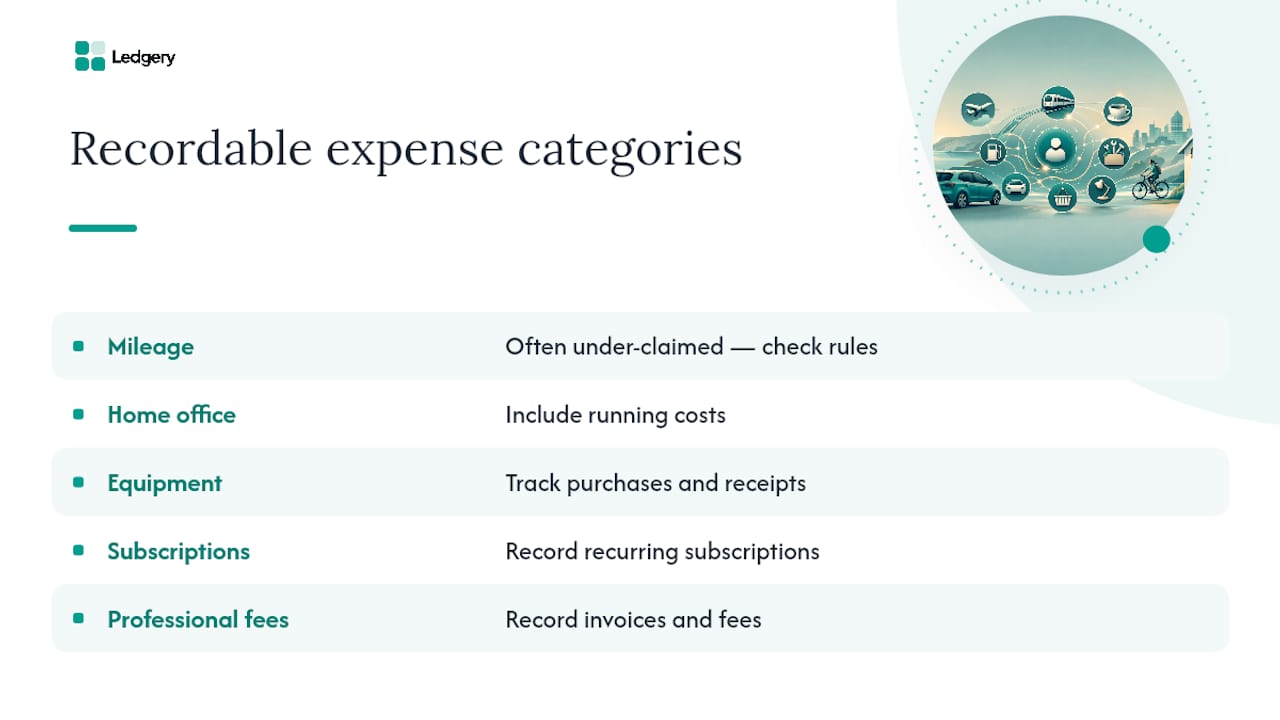
Common categories worth tracking properly include mileage, home office costs, equipment, subscriptions, and professional fees. Our allowable expenses guide breaks these down further, and if you drive for work, the mileage allowance rules are worth checking separately, since they’re often under-claimed.
Pro Tip: Run a rough profit check every quarter rather than waiting for year end. It gives you time to set aside money for both your Income Tax and Class 4 bill, instead of discovering the total in January. Ledgery’s receipt scanning captures expenses as they happen and builds quarterly summaries automatically, which removes the manual chasing that causes most missed deductions.
Quick checks: estimate your Class 4 bill in minutes
Three checks tell you most of what you need before doing any detailed sums:
- Compare profit to the LPL. Below £12,570, Class 4 doesn’t apply.
- Estimate a sample profit. At £30,000, you’d pay 6% on £17,430 (profit minus LPL), roughly £1,045.80.
- Check the payments on account threshold. If your total Self Assessment bill is large enough, expect instalments in January and July, not just one payment.
Round to the nearest penny once, at the final sum, not at each step, or small errors compound across the calculation.
Why regular checks beat year-end surprises
The mistake I see most often isn’t miscalculating Class 4, it’s not checking at all until the tax return is due. By then, there’s no time to adjust spending, set money aside, or query an expense that should have been claimed months earlier. A quarterly glance at profit against the LPL and UPL turns a January scramble into a non-event.
— Jason
How Ledgery helps you stay ahead of Class 4
Ledgery scans your receipts, sorts them into the right expense categories, and turns them into quarterly HMRC-ready summaries, so the profit figure behind your Class 4 calculation stays accurate without spreadsheet chasing.
It’s built for self-employed people who’d rather not spend an evening every quarter reconciling receipts, particularly anyone with a mix of expense types like mileage, equipment, and home office costs, where things get missed easily. The first quarter is free, so you can see how the receipt capture and deadline alerts work before committing to anything. If you’re earning above the LPL and want your Class 4 figure to be right rather than guessed, start your free quarter with Ledgery.
This article is general information, not a substitute for advice from a qualified financial advisor. Consult a qualified financial professional about your own circumstances before acting on anything here.
Sources
Recommended
Self-employment and property income in one subscription, first quarter free. Join the early access list and we’ll email you once, when it opens.
Join early access