Invoice requirements UK: what small businesses must include

Every UK invoice must show a unique invoice number, your name and contact details, the customer’s name and address, a description of the goods or services, the date of supply, the invoice date, itemised amounts, VAT if you charge it, and the total amount owed. These rules come from Gov and, for VAT-registered businesses, the VAT Regulations 1995.
- Check every invoice against the list above before you send it.
- If you’re VAT-registered, add the fuller VAT invoice fields covered below.
- Keep copies of every invoice for six years.
Key Takeaways
A legally compliant UK invoice needs a sequential number, full supplier and customer details, itemised amounts, correct dates, and VAT fields where you’re registered, kept on file for six years.
| Point | Details |
|---|---|
| Core fields are non-negotiable | Every invoice needs a unique number, supplier and customer details, description, dates, amounts and total. |
| VAT invoices need extra detail | Registered businesses must add VAT number, tax point, unit prices, VAT rate and amount per line. |
| Structure changes the supplier block | Sole traders use their own name and trading name; limited companies use the registered company name exactly. |
| Six-year retention applies to all formats | Paper and electronic invoices must be kept for six years with authenticity and integrity preserved. |
| Ledgery automates the repetitive parts | Sequential numbering, secure storage and HMRC-ready exports come built in, with a free first quarter. |
Table of Contents
- Invoice requirements UK: the full checklist and why each field matters
- VAT invoices: when you must issue one and what changes
- Sole traders versus limited companies: invoice differences you must apply
- When to issue invoices and how long to keep them
- Special cases: reverse charge, margin schemes, exports and self-billing
- What happens if an invoice is non-compliant
- How to make compliant invoices quickly
- Frequently asked questions
- Sources
Invoice requirements UK: the full checklist and why each field matters
A compliant UK invoice is not complicated, but missing one field can cause payment delays or problems if HMRC ever asks questions. Here’s what belongs on every invoice, and the reasoning behind each item.
Sequential invoice number. Every invoice needs a unique, sequential identifier. This isn’t a suggestion. It lets you and HMRC track every transaction in order, spot gaps, and cross-check your books during any enquiry. Skipping numbers, or reusing one, is one of the fastest ways to raise a red flag.
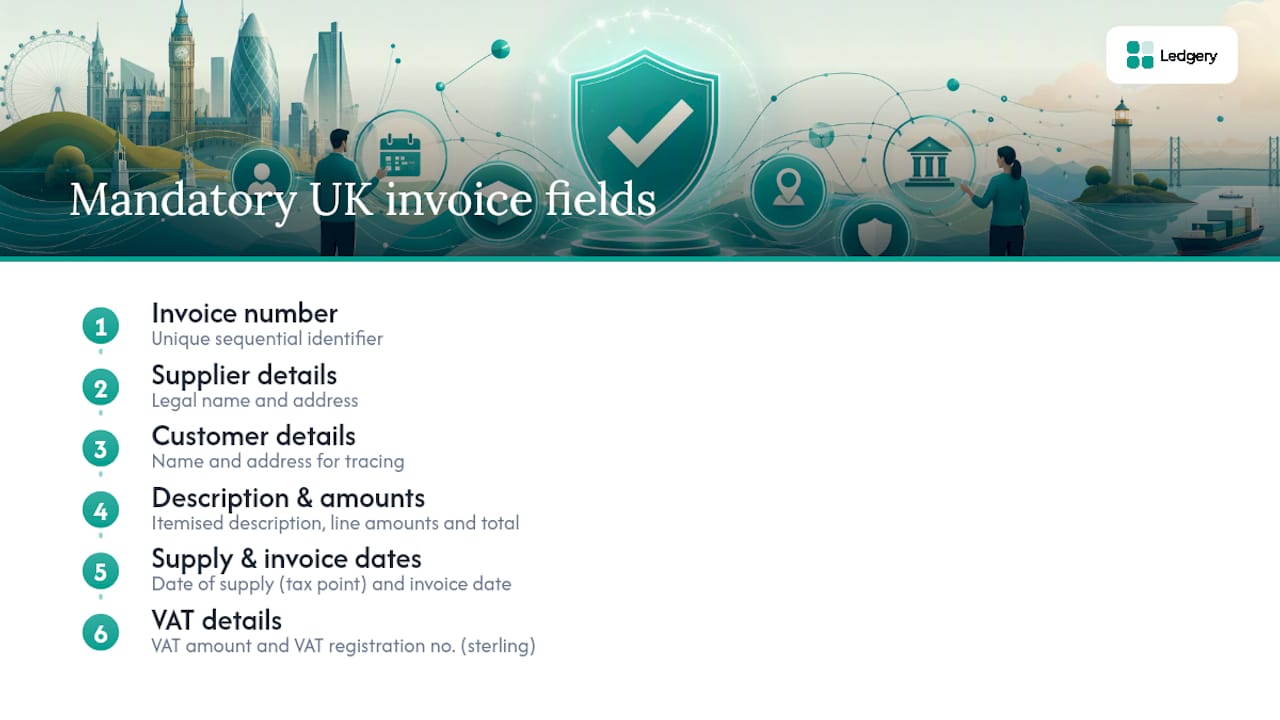
Your business details. Sole traders show their own name plus any trading name, alongside an address where legal documents can reach them. Limited companies use the exact name from their certificate of incorporation. If you list any directors, you must list them all, not just the ones who sign the invoices.
Customer name and address. This matters for every business-to-business sale and becomes essential when invoicing across borders, where HMRC or an overseas tax authority may need to trace the transaction.
Description, dates, and amounts. You need a clear description of what was supplied, the date of supply (sometimes called the tax point), the invoice date, itemised amounts for each line, and the total payable.
VAT specifics. If you charge VAT, the invoice must show the VAT amount separately and your VAT registration number.
Missing a single mandatory field doesn’t just look sloppy. It can delay payment, trigger client queries, or complicate a VAT reclaim months down the line.
On currency: invoices can be issued in any currency, but where UK VAT is due, the VAT amount itself must be shown in sterling, even if the rest of the invoice is in dollars or euros.
VAT invoices: when you must issue one and what changes

If you’re VAT-registered and you supply taxable goods or services to another VAT-registered business, you must issue a full VAT invoice. This isn’t optional once you’re above the VAT threshold and trading business to business.
A full VAT invoice needs everything on the standard checklist, plus:
- Your VAT registration number, shown clearly.
- The time of supply (the tax point), which may differ from the invoice date.
- Unit prices and quantities for each item or service.
- The VAT rate applied to each line, and the VAT amount for each rate.
- Gross and net totals, so the customer can see the VAT calculation clearly.
These particulars come directly from regulation 14 of the VAT Regulations 1995, which also sets out when simplified or modified invoice formats are acceptable. A simplified invoice is permitted for lower-value retail-style sales and drops some of the detail, but any full B2B transaction generally needs the complete version. A sale to an EU customer often carries your VAT number with a “GB” prefix, and a reverse charge transaction needs an explicit note stating that the customer accounts for the VAT, not you.
Sole traders versus limited companies: invoice differences you must apply
The core UK invoice regulations are identical whichever structure you trade under, but the supplier details differ.
- Sole traders: show your own name, plus any trading name you use, and an address where legal documents can be delivered, even if that’s different from your trading address.
- Limited companies: use the exact registered name from the certificate of incorporation. If director names appear anywhere on the invoice, every director must be listed, not a select few.
A sole trader might write “J. Patel trading as Patel Design Studio” above a home office address. A limited company writes “Patel Design Studio Ltd” exactly as registered at Companies House.
Pro Tip: Format your supplier block with the legal name first, in full, then your trading or brand name underneath in smaller text. This satisfies the legal requirement while still keeping your invoice looking professional.
When to issue invoices and how long to keep them
The general rule is that invoices must be issued within 30 days of the time of supply, or from the payment date if that comes first, under regulation 13 of the VAT Regulations. Some supplies carry different specified timeframes, so check the exceptions if you deal in continuous services or staged deliveries.
Once issued, you need to keep both sales and purchase invoices for six years. This applies equally to paper and electronic records, and HMRC expects electronic invoices to preserve authenticity of origin, integrity of content, and legibility throughout that period.
- Services: usually invoiced promptly after completion, within the 30-day window.
- Goods: typically invoiced at or shortly after delivery.
- Prepayments: invoice on receipt of payment if that happens before supply.
Pro Tip: Back up electronic invoices in at least two locations and keep an audit trail of any edits. A simple version history protects you if HMRC ever questions whether a record has been altered.
Special cases: reverse charge, margin schemes, exports and self-billing
Some transactions need specific wording beyond the standard fields.
- Reverse charge: state clearly that the customer must account for the VAT themselves, and show the amount they need to declare.
- Margin schemes: include the relevant reference, such as “margin scheme: works of art,” where the scheme applies.
- Self-billing: the customer raises the invoice on your behalf, but only under a prior written agreement, and the invoice must carry all the usual particulars plus the self-billing reference.
- Exports to the EU: show your VAT number with the “GB” prefix and include the customer’s VAT registration number where relevant.
What happens if an invoice is non-compliant
A missing field can delay payment, invite an HMRC enquiry, or block a VAT reclaim on the other side of the transaction.
- Issue a corrected invoice or credit note as soon as you spot the error.
- Reference the original invoice number on any credit note or correction, since corrective documents must identify the invoice they amend.
- Keep a clear record of why the correction was made.
How to make compliant invoices quickly
- Confirm the invoice number is sequential and hasn’t been used before.
- Check supplier and customer details are complete and correctly formatted for your business structure.
- Confirm the description, supply date, and invoice date are all present.
- Total the itemised amounts and add VAT lines if registered.
- Add any special reference (reverse charge, margin scheme, self-billing) if it applies.
A minimal template needs a supplier block, customer block, itemised rows, subtotal, VAT line, grand total, invoice number, and both dates. Look for software with automatic sequential numbering, built-in VAT fields, PDF export, and searchable storage. If you invoice overseas, keep an English translation ready, since HMRC can request one during a visit.
How Ledgery helps UK sole traders and landlords stay compliant
Ledgery generates sequentially numbered invoices, stores them securely, and exports records ready for HMRC review, covering income and property income.
- Sequential numbering handled automatically.
- Secure, searchable storage for the full six-year retention period.
- One-tap export when HMRC asks for records.
Pro Tip: Set your invoice template once inside Ledgery with your VAT details filled in, and every future invoice inherits the correct fields automatically.
A rule of thumb worth keeping on your desk
If in doubt, issue a full VAT-style invoice and keep six years of records regardless of your turnover. It costs you nothing extra and removes the guesswork that causes most HMRC friction. Run the pre-send checklist every time.
Fewer manual errors, one place for every invoice
Ledgery gives self-employed people and landlords a faster route to compliant invoicing than spreadsheets or paper templates ever managed.
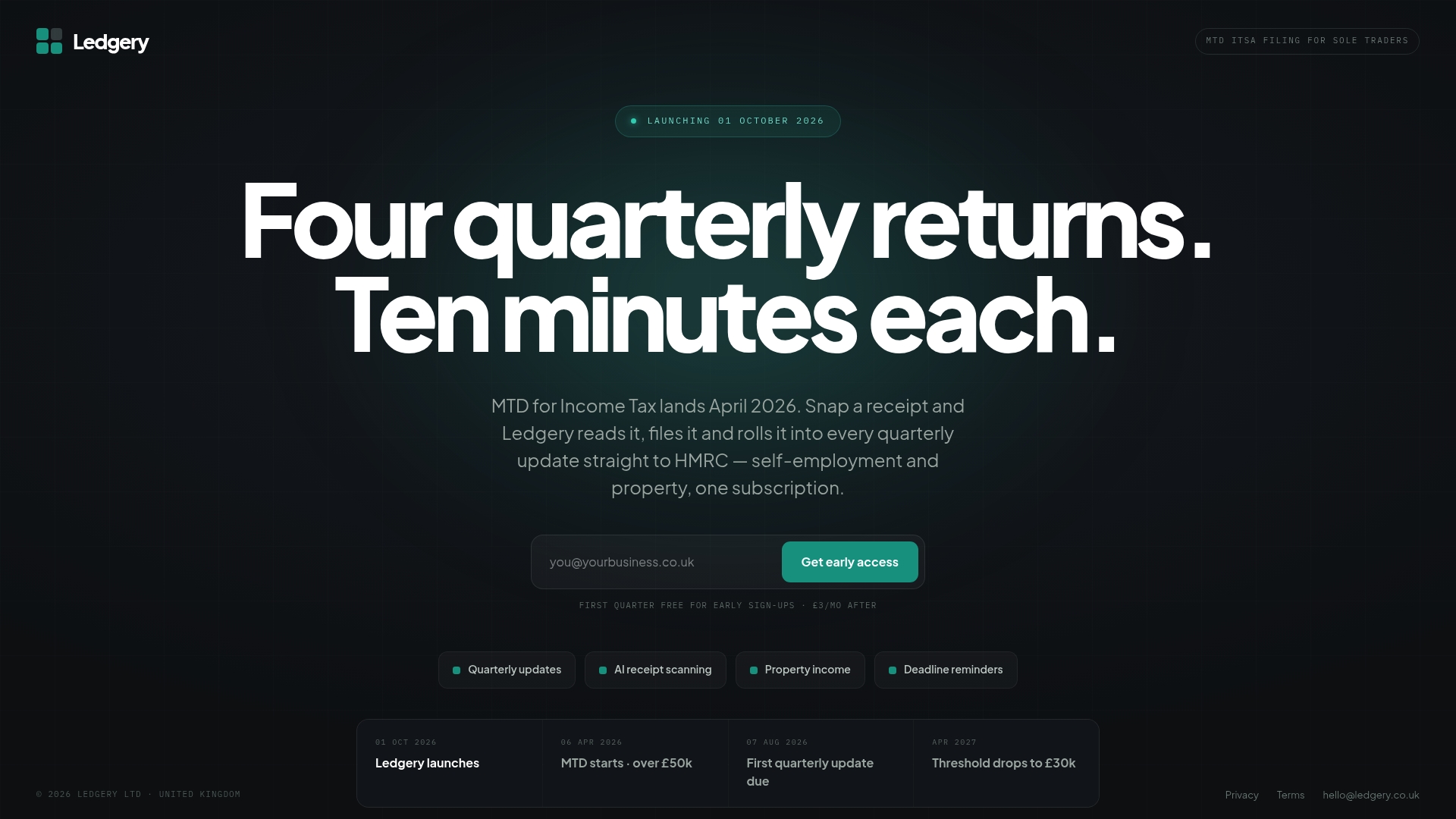
- Receipt scanning turns paper clutter into organised quarterly records automatically.
- Sequential invoice numbering and secure storage remove the two most common compliance gaps.
- Deadline alerts mean you’re never scrambling before an HMRC submission date.
The first quarter is free, which gives you time to see whether it fits your workflow before paying anything. If you earn over £50,000 and Making Tax Digital applies to you soon, it’s worth setting this up now rather than later. Visit the Ledgery landing page to start your free quarter.
Frequently asked questions
Do I need a VAT invoice if I’m not VAT-registered? No. Only VAT-registered businesses issue VAT invoices. Everyone else still follows the standard invoice requirements UK rules covering supplier details, dates, and totals.
What’s the difference between a full and simplified VAT invoice? A simplified invoice drops some detail and is generally used for lower-value retail-style sales, while a full VAT invoice lists unit prices, VAT rates per item, and gross and net totals separately.
How long must I keep invoices in the UK? Six years, for both paper and electronic records, with electronic copies needing to remain authentic, unaltered, and legible throughout.
Can I invoice in a foreign currency? Yes, but where UK VAT is due, the VAT amount itself must be shown in sterling even if the rest of the invoice uses another currency.
What should I do if I sent an invoice with a mistake? Issue a corrected invoice or credit note referencing the original invoice number, and keep a clear record of what changed and why.
This article is general information, not a substitute for advice from a qualified financial advisor. Consult a qualified financial professional about your own circumstances before acting on anything here.
Sources
Recommended
Self-employment and property income in one subscription, first quarter free. Join the early access list and we’ll email you once, when it opens.
Join early access