Landlord allowable expenses: what UK landlords can claim

UK residential landlords can deduct a range of allowable expenses from rental income to reduce their taxable profit, provided each cost is incurred wholly and exclusively for the rental business. The main deductible categories are repairs and maintenance, buildings and contents insurance, letting agent and management fees, utilities and council tax paid by the landlord, legal and professional fees, accountancy costs, and replacement of domestic items relief. Two major limits apply: capital improvements are not deductible against rental income, and mortgage interest no longer reduces rental profit directly.
Common deductible categories at a glance:
- Repairs and maintenance (restoring, not improving)
- Buildings and contents insurance premiums
- Letting agent fees and property management costs
- Utilities and council tax where the landlord pays them
- Legal and professional fees directly related to the tenancy
- Replacement of domestic items (furniture, white goods, like-for-like)
- Accountancy and tax return preparation fees
The sections below cover the HMRC tests that determine claimability, a full category-by-category list, the mortgage interest restriction, how to distinguish repairs from improvements, how to complete the SA105, record-keeping requirements, a worked numeric example, and the most common mistakes to avoid.
Key takeaways
| Point | Details |
|---|---|
| Wholly and exclusively test | Every expense must be incurred solely for the rental business; apportion mixed-use costs and document the method at the time. |
| Repairs vs capital | Repairs restoring original condition are deductible; improvements are capital and recorded for Capital Gains Tax instead. |
| Section 24 finance credit | Mortgage interest is not deducted from rental profit; a 20% tax credit is applied after tax is calculated, costing higher-rate taxpayers more. |
| SA105 boxes 24–29 | Enter all allowable expenses in the correct SA105 boxes, apply private-use adjustments, and keep supporting invoices for at least five years. |
| Ledgery for record-keeping | Ledgery’s AI receipt scanning and quarterly HMRC export features help landlords capture and organise expense evidence throughout the year. |
Table of Contents
- What HMRC rules decide whether an expense is allowable
- A category-by-category list of common allowable expenses
- How does the mortgage interest restriction (Section 24) work?
- Repairs vs improvements: how to classify expenditure correctly
- How to claim on Self Assessment using the SA105
- Good record-keeping makes every expense claim defensible
- Worked example: calculating taxable rental profit
- Common mistakes HMRC flags and costs you cannot claim
- A note on getting expense claims right
- Ledgery can help you keep on top of your expense records
- Essential HMRC and official guidance for UK landlords
- Sources
What HMRC rules decide whether an expense is allowable
The starting point is the “wholly and exclusively” test. HMRC allows a deduction only when the expense is incurred wholly and exclusively for the purpose of renting out the property. Where a cost has a dual purpose, for example a phone used for both personal calls and property management, only the portion that is clearly attributable to the rental business may be claimed. The apportionment method must be reasonable and documented at the time the cost is incurred, not reconstructed later.
The second key distinction is between revenue expenditure and capital expenditure. Revenue costs, such as routine repairs, insurance premiums, and agent fees, are deductible in the tax year they arise. Capital costs, such as an extension or a new kitchen that upgrades the property beyond its original condition, are not deductible against rental income. They are recorded separately because they can reduce Capital Gains Tax when the property is eventually sold.
The property income allowance is a flat £1,000 deduction available to landlords with small amounts of rental income. If you choose to use it, you cannot also claim actual expenses against that income. The SA105 notes explain the choice and the relevant boxes. For most landlords with meaningful costs, actual expenses will produce a lower taxable profit than the £1,000 allowance, but it is worth checking each year.
On accounting basis, most landlords use traditional (accruals) accounting, which matches income and expenses to the period they relate to. Cash basis is also available and records income and expenses when money actually changes hands. The cash basis turnover cap for property businesses is set out in the SA105 guidance; check the applicable threshold before choosing, as it affects how certain costs are treated.
Pro Tip: Document your apportionment method in a short written note at the time you incur the cost. For a shared phone or broadband line, record the percentage of use attributable to property management and keep that note with the invoice. HMRC expects contemporaneous evidence, not a retrospective estimate.
A category-by-category list of common allowable expenses
The following categories cover the most common deductible landlord costs. Each entry includes what qualifies, a concrete example, and the evidence to keep.
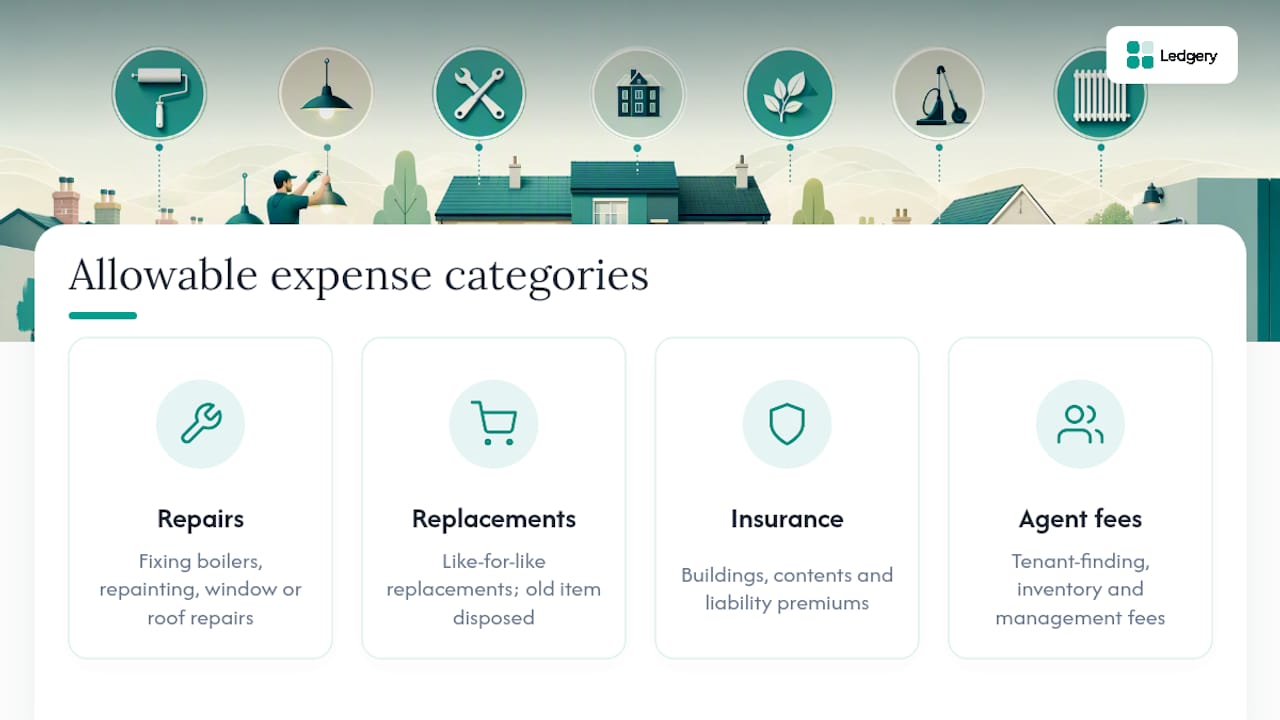
Repairs and maintenance covers work that restores the property to its original condition. Fixing a broken boiler, repainting after a tenancy, replacing a cracked window pane, and repairing a leaking roof all qualify. The cost of a like-for-like boiler replacement is allowable; upgrading to a higher-specification model is partly capital (see the capital vs revenue section below).
Replacement of domestic items relief applies when you replace furniture, furnishings, household appliances, or kitchenware in a residential letting. The relief covers the cost of a like-for-like replacement, not the original purchase. If you upgrade to a better item, the deduction is limited to the cost of an equivalent standard replacement. The old item must be disposed of. This relief has applied since 6 April 2016 and replaced the former wear and tear allowance.
Insurance premiums for buildings, contents, and landlord liability insurance are fully allowable. Keep the policy schedule and the premium invoice or direct debit confirmation.
Letting agent and management fees are fully deductible, including tenant-finding fees, inventory fees, and ongoing management charges. Tenant screening costs, such as referencing fees paid to an agent, fall into this category.
Rates and ground rents paid by the landlord, including council tax during void periods and ground rent on leasehold properties, are allowable.
Utilities such as gas, electricity, and water that the landlord pays are deductible. Where the tenant pays utilities directly, there is nothing to claim.
Legal and professional fees directly connected to the letting are allowable. Examples include the cost of drawing up a tenancy agreement, pursuing rent arrears through the courts, and eviction proceedings. Legal fees for buying or selling the property are capital and not deductible here.
Accountancy and tax return preparation fees for completing the property pages of your Self Assessment return are allowable.
Advertising and tenant-finding costs include online listing fees, newspaper advertising, and referencing costs not covered by an agent.
Travel and motoring costs are allowable only when the journey is made wholly and exclusively for the rental business, for example travelling to inspect the property or meet a contractor. HMRC accepts the approved mileage rate of 45p per mile for the first 10,000 business miles in a tax year, then 25p per mile. Personal detours or combined trips require apportionment. Keep a mileage log with dates, destinations, and purposes.

Service charges and communal costs on leasehold properties, such as building maintenance contributions, are allowable where the landlord pays them.
Irrecoverable debts (rent arrears that are genuinely unrecoverable and have been written off) are allowable under traditional accounting. Under cash basis, income is only recognised when received, so a bad debt does not arise in the same way.
One cost that landlords sometimes ask about is client gifts. Gifts to tenants or contractors are generally not allowable as a landlord business expense. HMRC’s rules on client gifts are strict: gifts are not deductible unless they carry a conspicuous advertisement for the business and cost no more than £50 per recipient per year. Even then, the rules apply to trading businesses rather than property letting in most cases. In practice, gifts to tenants are treated as personal expenditure.
How does the mortgage interest restriction (Section 24) work?
Mortgage interest and other finance costs are no longer deducted from rental income when calculating taxable rental profit. This change, introduced from 6 April 2017 and fully in effect from 2020/21, is known as Section 24 of the Finance Act 2015.
Finance costs that qualify for the credit include mortgage interest, arrangement fees spread over the loan term, and interest on loans taken out to fund improvements to the property. Mortgage capital repayments do not qualify.
The practical effect of Section 24 is that higher-rate taxpayers pay tax on rental income that includes their mortgage interest, then receive only a 20% credit back. A landlord paying 40% tax on rental profit effectively loses 20p in every pound of mortgage interest to additional tax compared with the pre-2017 position.
Basic-rate taxpayer example. Gross rent: £12,000. Allowable expenses (excluding finance costs): £3,000. Taxable rental profit: £9,000. Finance costs (mortgage interest): £4,000. Net tax payable: £1,800 minus £800 = £1,000.
Higher-rate taxpayer example. Same figures. Finance costs: £4,000. Net tax payable: £3,600 minus £800 = £2,800. The restriction costs this landlord an additional £800.
Pro Tip: If you hold a buy-to-let mortgage, consider speaking to a mortgage adviser about the structure of your finance costs. Some landlords find that buy-to-let mortgage arrangements affect their overall tax position significantly, particularly if they are higher-rate taxpayers or close to a tax band boundary.
Finance costs interact with the cash basis rules and joint ownership. Under cash basis, interest is deductible when paid. For jointly owned properties, each owner claims their share of finance costs in proportion to their ownership interest.
Repairs vs improvements: how to classify expenditure correctly
Repairs restore the property to its original condition and are revenue expenditure, deductible against rental income in the year incurred. Improvements add to or enhance the property beyond its original state and are capital expenditure, not deductible against rental income but recordable for Capital Gains Tax purposes.
The distinction is not always obvious, and it is one of the most common areas of dispute in HMRC enquiries. Detailed before/after evidence and itemised invoices materially reduce the risk of a challenge.
Clear examples:
- Fixing broken roof tiles: repair, allowable
- Adding a dormer loft conversion: improvement, capital
- Replacing a like-for-like boiler: allowable (also qualifies as replacement of domestic items relief if it is a domestic appliance)
- Upgrading from a standard boiler to a high-efficiency heat pump: partly capital, partly allowable
- Repainting walls after a tenancy: allowable
- Replacing single-glazed windows with double-glazed throughout: improvement, capital
Where a single invoice covers both repair and improvement elements, for example a contractor who fixes existing plumbing and also installs a new bathroom suite, the invoice should be split. The repair portion is deductible; the improvement portion is capital. Ask the contractor to itemise the invoice separately. If they will not, make a reasonable apportionment and document your method.
Capital expenditure is not deductible against rental income, but keeping accurate records of it matters. When the property is sold, those costs can reduce the chargeable gain and therefore the Capital Gains Tax payable.
Replacement of domestic items relief in practice. If a landlord replaces a washing machine that cost £300 originally with a standard equivalent costing £350, the full £350 is allowable. If they choose a premium model costing £600, the deduction is limited to £350 (the cost of a like-for-like replacement). The difference of £250 is not deductible.
How to claim on Self Assessment using the SA105
Allowable expenses are reported on the SA105 supplementary pages of the Self Assessment tax return. The SA105 form and notes set out which boxes to complete for each expense category.
The direct answer: enter total allowable expenses in boxes 24 to 29 of the SA105, making any private-use adjustments before entering the figures. If you are using the property income allowance instead of actual expenses, tick the relevant box and do not enter expense figures.
Step-by-step process:
- Gather all income and expense totals for the tax year (6 April to 5 April).
- Decide whether to use the property income allowance (£1,000 flat deduction) or actual expenses. Run both calculations; the allowance is only beneficial if actual expenses are below £1,000.
- Choose your accounting basis. Most landlords use traditional accounting. If using cash basis, record income and expenses when money changes hands.
- Enter gross rental income in box 20 of the SA105.
- Enter allowable expenses in the relevant boxes (24 to 29): repairs and maintenance, insurance, loan interest (for the finance cost credit calculation), legal and professional fees, management fees, and other allowable property expenses.
- Apply private-use adjustments. If any expense has a personal element, enter only the business proportion.
- Calculate the taxable rental profit (income minus allowable expenses) and carry it forward to the main tax return.
- The finance cost credit is calculated separately and applied after your income tax liability is worked out.
For jointly owned properties, each owner completes their own SA105 and claims their proportionate share of income and expenses. The default split for married couples and civil partners is 50/50, but a different split can be declared using Form 17 if the property is held in unequal shares.
Documents to have ready before filing:
- Rental income statements or bank records showing rent received
- Agent statements showing fees deducted
- Invoices and receipts for all claimed expenses
- Mortgage statements showing interest charged
- Mileage log for travel claims
- Evidence of any private-use apportionment
Good record-keeping makes every expense claim defensible
Clear, organised records are the foundation of a defensible tax return. HMRC can open an enquiry into a Self Assessment return for up to 12 months after the filing deadline, and up to four years where there is an innocent error, so records need to be kept for at least five years after the 31 January filing deadline for the relevant tax year.
Records to keep for each property:
- Invoices and receipts for every expense claimed, showing the supplier, date, amount, and description
- Bank statements showing payments made and rent received
- Tenancy agreements and renewal documents
- Deposit protection records
- Mortgage statements showing interest charged each year
- Mileage log with dates, destinations, and business purpose
- Before/after photographs for any repair or replacement work
- Correspondence with agents, contractors, and tenants relevant to costs incurred
- Apportionment calculations and the written notes supporting them
HMRC expects VAT invoices where a supplier is VAT-registered, as these confirm the supplier’s identity and the nature of the supply. A bank statement alone is not sufficient evidence for most expense claims.
Digital tools reduce the risk of missing receipts and make quarterly reporting more manageable. Ledgery, for example, offers AI-powered receipt scanning that captures and categorises expenses automatically, stores records digitally, and generates quarterly HMRC update exports. For landlords preparing for Making Tax Digital (MTD), which will require quarterly digital reporting, having a system that captures receipts at the point of purchase is considerably more reliable than reconstructing records at year-end. Managing multiple rental properties digitally also reduces the risk of mixing up expenses across different properties.

Pro Tip: Set up a simple naming convention for digital receipts: [YYYY-MM-DD] [Property address abbreviation] [Supplier] [Amount]. For example: 2025-09-15 FlatA-Manchester PlumbingCo £240. Link each file to the SA105 box it relates to in a simple spreadsheet. This makes apportionment checks and any HMRC enquiry straightforward.
Worked example: calculating taxable rental profit
A worked example shows how the two main adjustments, allowable expense deductions and the finance cost credit, combine to produce the final tax figure. The HMRC case studies follow the same structure.
The mortgage interest of £5,000 does not reduce the taxable rental profit. The difference illustrates why the Section 24 restriction has a much larger impact on higher-rate taxpayers.
Each line in the expense total requires a corresponding invoice or receipt.
Common mistakes HMRC flags and costs you cannot claim
Several categories of expenditure are routinely disallowed, and a small number of errors account for the majority of HMRC enquiries into property income returns.
Costs that are not allowable:
- Capital improvements (extensions, loft conversions, new kitchens that upgrade the property)
- Mortgage capital repayments (only the interest element qualifies for the credit)
- Personal costs and private expenditure
- Life insurance and income protection premiums
- Business entertaining and gifts to tenants in most cases (see the note on client gifts above)
- Legal fees for buying or selling the property
- Costs of the landlord’s own time
HMRC routinely scrutinises “miscellaneous” or poorly documented claims. The wholly-and-exclusively test is applied strictly in practice. A claim that cannot be supported by a contemporaneous invoice and a clear business purpose is at risk of disallowance, with potential interest and penalties on top.
Frequent mistakes that invite closer scrutiny:
- Claiming the full cost of a dual-purpose expense without apportionment (for example, a phone or broadband line used personally and for property management)
- Missing receipts or relying on bank statements alone as evidence
- Misclassifying capital work as a repair (for example, describing a full bathroom replacement as “maintenance”)
- Overstating mileage or claiming personal journeys
- Claiming the whole mortgage payment rather than just the interest element
- Claiming costs incurred before the first letting (pre-letting expenses are generally not allowable unless the property was available to let)
- Failing to apportion expenses on a property that is partly used personally (for example, a holiday home let for part of the year)
If HMRC opens an enquiry, respond promptly, provide the requested evidence, and consider engaging a tax adviser. An adviser can help present apportionment calculations clearly and negotiate where the classification of expenditure is genuinely borderline.
A note on getting expense claims right
The landlords who face the fewest problems with HMRC are not necessarily those with the simplest tax affairs. They are the ones who keep clear records throughout the year and classify expenditure correctly at the time it is incurred, not at filing time.
The highest-impact actions are straightforward: capture receipts digitally as soon as a cost is incurred, write a brief note on any apportionment at the same time, and keep a separate record of capital expenditure even though it is not deductible now. That capital record will matter when the property is sold.
The Section 24 mortgage interest restriction is the area where a calculation error has the largest financial consequence, particularly for higher-rate taxpayers. Running the numbers before filing, rather than assuming the return is straightforward, is worth the time.
When the tax position is complex, for example where there are multiple properties, joint ownership with unequal shares, or significant capital works, consulting a qualified tax adviser or chartered accountant is the right call. The cost of that advice is itself an allowable expense.
Ledgery can help you keep on top of your expense records
Keeping accurate expense records throughout the year is the single most effective way to protect your tax claims and prepare for Making Tax Digital. Ledgery is built for exactly this: snap a photo of a receipt, and the AI-powered scanner captures, categorises, and stores the expense automatically. Your records are organised by property and expense category, ready to export as a quarterly HMRC update when you need it.

The first quarter is free, so you can test the receipt capture and expense organisation features before committing to a subscription. Ledgery is not a tax adviser and does not replace professional advice, but it gives you the organised, timestamped records that make every claim defensible. Visit Ledgery to start your free trial quarter and see how it fits your record-keeping routine.
Essential HMRC and official guidance for UK landlords
Use these sources to verify current thresholds and rules before filing. Figures and limits can change each tax year.
- Gov: the main HMRC guidance page covering allowable expenses, the wholly-and-exclusively test, replacement of domestic items relief, and the property income allowance.
- Gov: step-by-step worked examples showing how to calculate taxable rental profit and apply tax bands.
- SA105 notes 2025 (GOV.UK PDF): guidance on completing the property supplementary pages, including boxes 24–29, private-use adjustments, and the property income allowance.
- SA105 form 2025 (GOV.UK PDF): the actual SA105 supplementary pages for the 2024/25 tax year.
- HMRC Property guidance PDF: detailed HMRC technical guidance on finance costs restriction, cash basis, and replacement relief.
- Gov: explains how capital expenditure on a rental property is treated on disposal and how to calculate the chargeable gain.
Check each source for the current tax year’s figures before completing your return, as thresholds, rates, and allowances are subject to change in each Budget.
This article is general information, not a substitute for advice from a qualified financial advisor. Consult a qualified financial professional about your own circumstances before acting on anything here.
Sources
- Gov
- Gov
- Use these notes to help you fill in the SA105 supplementary pages (SA105 notes) - GOV.UK (2025 pdf)
- UK Property (HMRC guidance PDF) - HMRC
- Gov
- SA105 supplementary pages (2025 pdf) - GOV.UK
Recommended
Self-employment and property income in one subscription, first quarter free. Join the early access list and we’ll email you once, when it opens.
Join early access