Subsistence expenses UK: what employees and the self-employed can claim

Subsistence expenses are the meals, accommodation and incidental costs you incur because you had to travel away from your normal workplace. Employees and the self-employed can both claim them, but the process differs, and HMRC applies one governing test throughout: the cost has to be reasonable, business-related and supported by evidence.
- Employees generally claim through their employer, who may use scale rates or reimburse actual costs.
- Self-employed people claim actual, reasonable costs on their tax return, with no automatic daily allowance.
- Read on for HMRC’s benchmark rates, employer reporting duties, and exactly what evidence to keep.
Key Takeaways
Subsistence expenses in the UK are claimable when costs are reasonable, business travel related and backed by receipts, but the claiming route differs sharply between employees and the self-employed.
| Point | Details |
|---|---|
| Apply the reasonableness test | Ask whether the cost only arose because of business travel; extravagant claims invite scrutiny. |
| Know your claiming route | Employees go through employer reimbursement and P11D or FPS; the self-employed claim actual costs directly. |
| Treat round-sum allowances carefully | Unapproved flat allowances count as taxable pay, triggering PAYE and National Insurance. |
| Keep contemporaneous evidence | Receipts, booking confirmations and short trip notes make claims far harder to challenge. |
| Automate receipt capture | Tools like Ledgery turn scattered receipts into quarterly, HMRC-ready records automatically. |
Table of Contents
- What HMRC means by subsistence expenses in the UK
- Employees, self-employed and directors: who claims what
- What counts as subsistence: meals, hotels and grey areas
- HMRC scale rates, bespoke rates and what employers must report
- Keeping records that actually hold up
- Worked examples: subsistence claims in practice
- How receipt automation reduces subsistence compliance risk
- Why the paperwork matters more than the pound signs
- Frequently asked questions
- Sources
What HMRC means by subsistence expenses in the UK
HMRC defines subsistence as the meals, drinks, overnight accommodation and incidental costs linked to business travel away from your normal workplace. It sits apart from most other allowable expenses because there’s no single published rate that covers every situation.
HMRC’s own internal manuals warn against relying on generalised subsistence figures, stating plainly that no universal domestic rate applies across the board. Instead, everything comes back to reasonableness. A moderate lunch on a day trip to Leeds is typical. Extravagant dinners with costly extras tend to attract closer scrutiny during any HMRC review.
Employees, self-employed and directors: who claims what
The claiming process depends entirely on your employment status, and mixing up the rules is one of the most common mistakes we see.
- Employees: your employer reimburses subsistence directly, often using HMRC’s benchmark scale rates, and reports the payment through P11D or Full Payment Submission depending on how it’s processed.
- Self-employed sole traders: there’s no blanket daily allowance. You claim actual, reasonable costs backed by receipts, and the amount interacts with your trading allowance and any simplified expenses you use elsewhere.
- Company directors: broadly follow employee rules but face extra scrutiny on round-sum or discretionary payments.
- Secondees and temporary workers: subsistence often hinges on whether the workplace counts as temporary, which affects what’s allowable.
What counts as subsistence: meals, hotels and grey areas
Claimable costs share one thing in common: they exist because business travel took you away from your normal working pattern.
- Meals on a genuine business trip — lunch during a client visit in another city, or dinner during an overnight stay.
- Overnight accommodation — hotel costs when a trip requires you to stay away from home.
- Incidental travel costs — parking, tolls and similar charges tied directly to the journey.
What doesn’t qualify is just as important. Ordinary commuting between home and your regular workplace is never allowable, no matter how far you travel. Everyday desk lunches don’t count either, since they’re not linked to travel. Client entertaining sits in a different tax category entirely, with its own rules on deductibility.
Three borderline cases show how to think it through. A consultant working from a client’s office for six months might have created a temporary workplace, changing what’s claimable. A freelancer grabbing a sandwich near their usual desk hasn’t travelled anywhere unusual, so it doesn’t qualify. A tradesperson stopping for fuel and a coffee between two site visits in the same day can usually claim the coffee as incidental to the business journey.

Pro Tip: If you’re unsure whether a cost qualifies, ask yourself: would I have spent this money if I hadn’t needed to travel for work? If the answer’s no, it’s a strong candidate for a genuine subsistence claim.
HMRC scale rates, bespoke rates and what employers must report
Employers have three practical routes for handling subsistence: pay HMRC’s published benchmark scale rates, apply for a bespoke rate agreed directly with HMRC, or reimburse actual costs against receipts.
Benchmark rates let employers pay set amounts tax-free without needing individual receipts for every meal, but HMRC’s own guidance is cautious about their use, stressing that generic rates aren’t automatically authorised for every scenario. A bespoke rate goes further: it’s a rate an employer negotiates and agrees with HMRC based on their own expense data, and it comes with an ongoing duty to prove the rate genuinely reimburses costs rather than topping up salary.
- Reimbursements and non-exempt benefits get reported on P11D, or through FPS where they’re processed via payroll.
- Employers report Class 1A National Insurance on P11D(b).
- Round-sum allowances that HMRC hasn’t approved count as taxable pay, triggering PAYE and NIC in the normal way.
- Employees can claim tax relief on the gap if their employer pays less than the actual cost incurred.
Getting the reporting wrong has a direct cost. An unapproved round-sum allowance doesn’t just risk a query, it gets treated as ordinary salary, meaning both employer and employee pay tax and National Insurance on money that was only ever meant to cover a hotel bill.
Keeping records that actually hold up
Good record keeping isn’t about hoarding paper. It’s about being able to answer one question quickly if HMRC ever asks: why did this cost happen, and how does it connect to your work?
- Receipts and invoices for every claimed cost, ideally itemised rather than just a card slip.
- Booking confirmations for hotels, trains or flights that back up the trip itself.
- A short contemporaneous note for any cost where a receipt genuinely isn’t available.
- Retention for at least five years after the relevant tax year for self-employed records, matching HMRC’s standard self-assessment requirement.
Link every record to a business purpose: the client name, the meeting date, the site you visited. A hotel receipt with no context is far weaker evidence than one filed alongside a diary note saying why you were there.
Pro Tip: Photograph receipts the moment you get them. A crumpled slip found three months later in a coat pocket is far harder to match to the right trip than one logged the same day.
Worked examples: subsistence claims in practice
- One-day client visit to Manchester. Lunch and train fare qualify as subsistence, keep the receipt and note the client’s name and meeting purpose. The commute from home to your usual office the day before doesn’t count.
- Overnight industry conference. Hotel and evening meal are claimable if the venue counts as a temporary workplace. If your employer reimburses this, they report it via P11D or FPS depending on their payroll setup, and it shouldn’t be treated as extra salary.
- Self-employed contractor visiting sites occasionally. Claim actual costs for meals and parking, and keep a short trip diary recording the date, site and reason for travel, which strengthens the claim if HMRC queries it later.
How receipt automation reduces subsistence compliance risk
Publisher note: the following describes Ledgery’s own product.
Chasing crumpled receipts months after a trip is exactly the scenario that weakens a subsistence claim. Ledgery scans receipts the moment they’re taken and organises them automatically into quarterly, HMRC-ready summaries, which matters increasingly as Making Tax Digital requirements extend to more self-employed people.
- Receipt scanning that captures the date, amount and merchant automatically.
- Automatic sorting into quarterly updates ready for HMRC submission.
- Deadline alerts so quarterly filings don’t slip.
- Stored digital copies that stand up if HMRC asks for evidence later.
A subsistence claim is only as strong as the paperwork behind it. The faster a receipt gets logged and linked to its business purpose, the harder it is to challenge months down the line.
For sole traders and property owners earning over £50,000, where MTD obligations bite hardest, this kind of automated record keeping turns a quarterly scramble into a five-minute check. Ledgery offers a free first quarter, so you can see whether it fits your workflow before committing.
Why the paperwork matters more than the pound signs
Most guidance on subsistence expenses fixates on rates and thresholds, as if the hard part is knowing what number to write down. It isn’t. The hard part is proving, months later, that a £40 hotel dinner genuinely happened because of work and not because you fancied a night out.
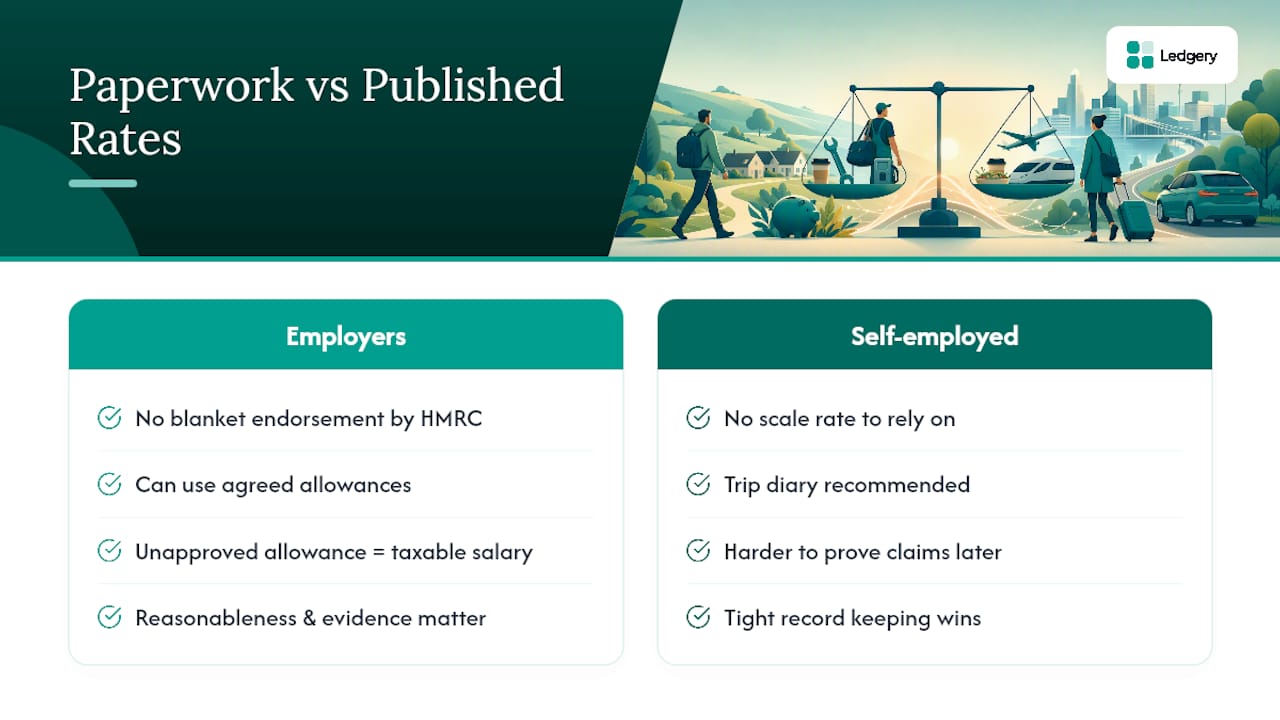
HMRC’s own manuals make this explicit by refusing to endorse blanket rates for general use. That’s a deliberate signal that reasonableness and evidence carry more weight than any published figure. Employers who lean too hard on round-sum allowances without HMRC agreement are taking a bigger risk than they realise, since an unapproved allowance simply becomes salary in HMRC’s eyes.
The self-employed have it slightly harder, since there’s no scale rate to fall back on at all. A trip diary sounds tedious, but it’s the difference between a claim that survives a query and one that doesn’t. My honest take: the businesses that get this right aren’t the ones with the most generous allowances, they’re the ones with the tightest record keeping.
Frequently asked questions
Can I claim subsistence expenses if I’m self-employed? Yes. Self-employed people can claim actual, reasonable subsistence costs when travel takes them away from their normal working pattern, but there’s no fixed daily allowance, so receipts and contemporaneous notes matter far more than for employees using scale rates.
What’s the difference between subsistence and per diem rates in the UK? UK per diem rates typically refer to HMRC’s benchmark scale rates, which employers can pay tax-free for meals during qualifying travel. Subsistence is the broader category covering meals, accommodation and incidental costs, whether reimbursed via scale rates or claimed as actual, receipted expenditure.
Do I need a receipt for every subsistence claim? Wherever possible, yes. Where a receipt genuinely isn’t available, a contemporaneous note recording the date, amount and business purpose is the next best evidence, though receipts remain the strongest support for any claim.
Does commuting count as a subsistence expense? No. Ordinary travel between home and your regular workplace is never allowable, regardless of distance or cost, because it isn’t linked to a temporary business journey.
What happens if my employer pays a round-sum subsistence allowance without HMRC approval? It gets treated as taxable pay, meaning both employer and employee owe PAYE and National Insurance on it, unless the employer has agreed a bespoke rate or uses HMRC’s published benchmark scale rates correctly.
This article is general information, not a substitute for advice from a qualified financial advisor. Consult a qualified financial professional about your own circumstances before acting on anything here.
Sources
- Expenses and benefits: travel and subsistence
- Subsistence expenses for sole traders: meals, hotels and what you can claim
Recommended
Self-employment and property income in one subscription, first quarter free. Join the early access list and we’ll email you once, when it opens.
Join early access