UK trading allowance: the £1,000 rule explained

The UK trading allowance lets individuals earn up to £1,000 from self-employment or casual trading in a tax year without paying income tax on it. If your gross trading income stays at or below £1,000, you generally have no obligation to register for Self Assessment or report that income to HMRC. Cross that threshold and you must act.
Here is the short verdict:
-
Gross income £1,000 or less: full relief applies; you usually do not need to notify HMRC or file a return for that income alone.
-
Gross income over £1,000: you must register for Self Assessment and choose between deducting the £1,000 allowance or claiming your actual allowable expenses. You cannot use both.
-
Connected-party income or partnership income: the allowance does not apply regardless of the amount.
The allowance is set out in Schedule 3 of the Finance (No. 2) Act 2017 and is covered in detail on Gov. The Low Incomes Tax Reform Group (LITRG) provides plain-English guidance for anyone unsure how to apply it.
Key takeaways
The £1,000 UK trading allowance gives full tax relief when gross income stays at or below that threshold, but once you exceed it, comparing actual expenses against the flat deduction is the only way to know which option saves you more tax.
| Point | Details |
|---|---|
| £1,000 threshold | Gross trading income at or below £1,000 usually requires no Self Assessment registration or HMRC notification. |
| Two options above £1,000 | Deduct the £1,000 allowance or claim actual expenses; you cannot combine both in the same year. |
| Aggregation rule | The £1,000 limit applies across all your trading activities combined, not separately per activity. |
| Registration deadline | Register for Self Assessment by 5 October following the tax year you exceeded £1,000. |
| Ledgery | Automates receipt capture and organises quarterly HMRC summaries, making record-keeping straightforward once you cross the threshold. |
Table of Contents
-
How is gross trading income defined, and what if you have multiple income sources?
-
Record-keeping, registering for Self Assessment and key deadlines
-
How does the trading allowance affect Universal Credit, student loans and National Insurance?
-
Common mistakes with the trading allowance and how to fix them
-
Ledgery takes the admin out of Self Assessment for small earners
How does the UK trading allowance work?
The trading allowance is a statutory relief introduced by Schedule 3 of the Finance (No. 2) Act 2017. It applies to trading income and certain miscellaneous income received by individuals, but excludes income from partnerships, from one’s own employer, or from companies controlled by the individual or connected persons.
The GOV.UK guidance states clearly: “If your total trading or miscellaneous income is £1,000 or less, you may not need to tell HMRC. If it’s more than £1,000, you can either claim the trading allowance or deduct your actual expenses — not both.”
Who can use it:
-
Self-employed sole traders with small or irregular income
-
Individuals earning from casual services (babysitting, gardening, dog walking)
-
People hiring out personal equipment (tools, cameras, vehicles)
-
Occasional freelancers (graphic design, copywriting, tutoring)
Who cannot use it:
-
Partners in a business partnership
-
Employees receiving income from their own employer
-
Individuals receiving income from a company they or a connected person controls
The allowance is applied to gross income, meaning total receipts before any expenses are deducted. It cannot create or increase a trading loss. If you elect partial relief, you deduct £1,000 from gross income to arrive at taxable profit. If you elect actual expenses, you deduct your real allowable costs and any capital allowances instead. The HMRC Business Income Manual at BIM86000 confirms the allowance is entirely optional and that loss-making traders should generally avoid electing it.
What if your gross trading income is £1,000 or less?
Full relief applies. Your trading income is effectively exempt from income tax and you do not normally need to register for Self Assessment or notify HMRC solely because of that income.
Exceptions: you must still tell HMRC if any of the following apply:
-
You have other untaxed income that already requires a Self Assessment return.
-
Your income came from a connected party (an employer or a company you control), which disqualifies the allowance.
-
You want to register a trading loss to carry forward against future profits.
-
HMRC has already sent you a notice to file a return.
-
You receive income from a partnership.
If none of those apply, you can simply keep basic records and move on.
What records to keep even when no return is required:
Keep a note of your total gross receipts for the year, any invoices or payment confirmations, and the dates of transactions. HMRC can open an enquiry up to four years after the relevant tax year in most cases, so retain records for at least five years from 31 January following the tax year. A simple spreadsheet or a folder of screenshots is enough at this level.
Pro Tip: Even if you are comfortably under £1,000 this year, track your income month by month. Side-hustle income has a habit of creeping past the threshold mid-year, and catching it early means you register on time rather than in a panic.
What if your gross trading income is more than £1,000?
Once you exceed £1,000, you have two options. Neither is automatically better; the right choice depends on your actual costs.
Option 1: partial relief (deduct the £1,000 allowance)
Step 1: Add up all gross trading receipts for the tax year. Step 2: Subtract £1,000. Step 3: The result is your taxable profit. Report this on your Self Assessment return.
Option 2: actual allowable expenses
Step 1: Add up all gross trading receipts. Step 2: Subtract all allowable business expenses (materials, travel, software, professional fees, and so on). Step 3: Subtract any capital allowances. Step 4: The result is your taxable profit.
Worked examples
Example A — partial relief wins
Gross income: £1,400. Actual expenses: £200.
-
Partial relief: £1,400 − £1,000 = £400 taxable profit.
-
Actual expenses: £1,400 − £200 = £1,200 taxable profit.
Use partial relief. You pay tax on £400 instead of £1,200.
Example B — actual expenses win
Gross income: £3,000. Actual expenses: £2,200.
-
Partial relief: £3,000 − £1,000 = £2,000 taxable profit.
-
Actual expenses: £3,000 − £2,200 = £800 taxable profit.
Use actual expenses. You pay tax on £800 instead of £2,000.
Example C — loss position (do not use the allowance)
Gross income: £900. Actual expenses: £1,100. The business made a £200 loss.
The allowance cannot create or increase a loss, so electing it here would simply give £0 taxable profit with no loss to carry forward. If you want to preserve that £200 loss for future years, calculate normally using actual expenses and do not elect the allowance. The LITRG guidance on calculating self-employed profits covers this scenario in detail.
Decision guide
| Situation | Better option |
|---|---|
| Expenses under £1,000 | Trading allowance (partial relief) |
| Expenses over £1,000 | Actual expenses |
| Business making a loss | Actual expenses (preserve the loss) |
| High start-up costs with capital allowances | Actual expenses |
| Minimal records kept | Trading allowance (simpler) |
Pro Tip: The election is made on your Self Assessment return each year. You are not locked in permanently. If your expenses jump significantly next year, you can switch to actual expenses for that year.
How is gross trading income defined, and what if you have multiple income sources?
Gross trading income means your total receipts before deducting anything. This catches out a lot of people who receive payments via platforms that take a commission before paying out. The £1,000 threshold is based on what you received in total, not what the platform transferred to your bank after its fees.
HMRC guidance flags this explicitly: if a platform deducts fees before paying you, your gross income is still the full amount before those fees. Use the gross figure, not the net payout.
Key aggregation rules:
-
The £1,000 trading allowance is per individual, not per activity. If you sell handmade goods and do occasional tutoring, both income streams count together toward the single £1,000 limit.
-
Trading income and property income are separate categories, each with its own £1,000 allowance. A separate property income allowance exists under the same legislation but cannot be transferred to cover trading income.
-
You can allocate the allowance across activities in whatever way you choose, but the total relief cannot exceed £1,000.
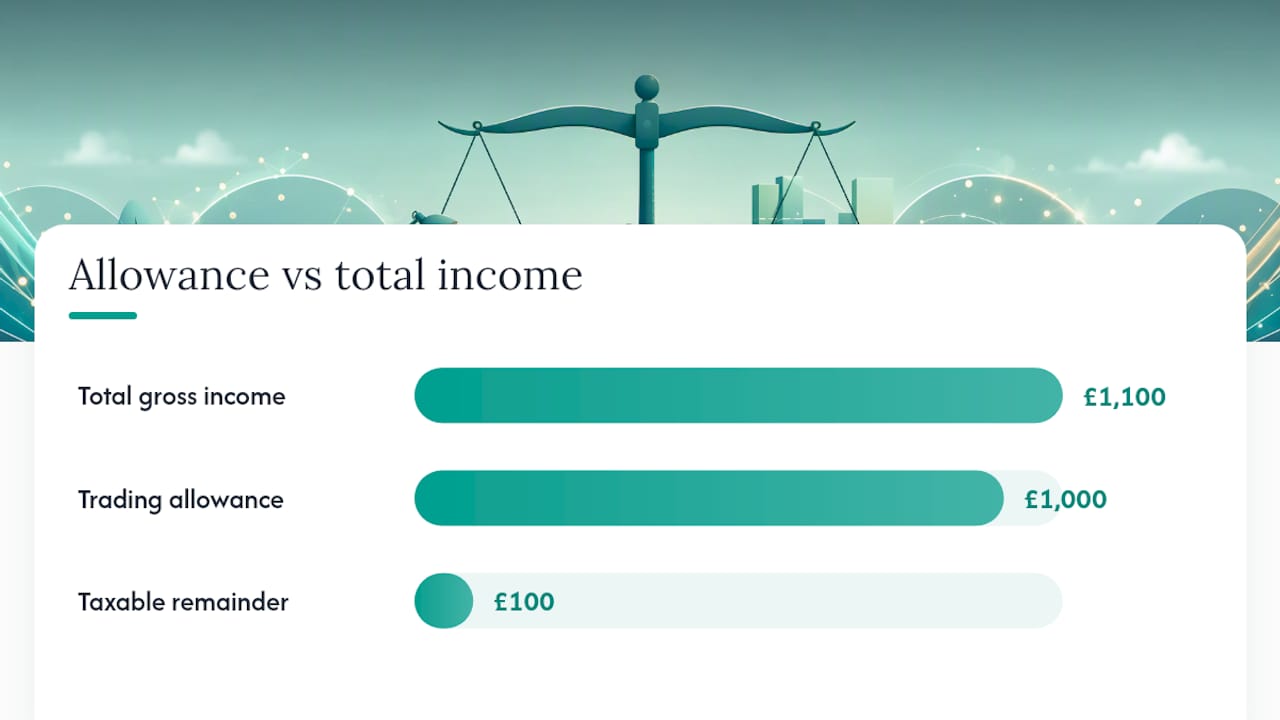
Example: You earn £400 from selling crafts and £700 from occasional gardening. Total gross trading income: £1,100. The allowance is £1,000 across both activities combined, leaving £100 taxable profit under partial relief. You cannot claim £1,000 against each activity separately.
Schedule 3 of the Finance (No. 2) Act 2017 sets the allowance at £1,000 per individual per category, and this aggregation rule is one of the most commonly misunderstood aspects of the relief.
Record-keeping, registering for Self Assessment and key deadlines
What records to keep
Good records do not need to be complicated. Keep:
-
A log of all sales and income received (date, amount, source)
-
Invoices or receipts you issued to customers
-
Receipts and invoices for any business expenses
-
Bank statements showing business transactions
-
Records of any assets purchased for the business
Retain all records for at least five years and ten months from the end of the relevant tax year (the standard HMRC retention period for Self Assessment).
When and how to register
If your gross trading income exceeds £1,000 in a tax year, you must register for Self Assessment. The registration deadline is 5 October following the end of the tax year in which you exceeded the threshold. Miss it and HMRC may charge a penalty.
Steps to register:
-
Go to the Self Assessment registration page on GOV.UK.
-
Create or sign in to your Government Gateway account.
-
Complete the CWF1 form (for self-employment) online.
-
HMRC will send your Unique Taxpayer Reference (UTR) by post within ten working days.
-
Use the UTR to file your return and pay any tax owed.
Key Self Assessment deadlines
| Deadline | Date | What it covers |
|---|---|---|
| Register for Self Assessment | 5 October (after tax year ends) | New traders exceeding £1,000 threshold |
| Online return filing | 31 January (following tax year) | Submit your Self Assessment return |
| Tax payment | 31 January (following tax year) | Pay any income tax and Class 4 NICs owed |
| Paper return filing | 31 October (following tax year) | If filing a paper return instead |
Late filing penalties start at £100 and increase the longer the return remains outstanding.
How does the trading allowance affect Universal Credit, student loans and National Insurance?
Universal Credit
The trading allowance is not recognised for Universal Credit purposes. The Department for Work and Pensions (DWP) requires your full gross income and actual expenses to assess your entitlement. If you use the £1,000 trading allowance on your tax return, DWP will still use a different calculation based on actual receipts and costs. LITRG warns that this can result in a higher income figure being used for benefit calculations than the taxable profit on your tax return.
Example: Gross trading income £1,400, actual expenses £600. Tax return shows £400 taxable profit (using partial relief). DWP calculates Universal Credit using £800 net profit (£1,400 − £600). Your benefit entitlement is based on the higher figure.
National Insurance and student loans
Class 4 National Insurance Contributions and student loan repayments are both calculated on your taxable profit after applying whichever method you elect (allowance or actual expenses). Using the trading allowance to reduce taxable profit therefore also reduces Class 4 NIC and student loan repayments for that year.
Pro Tip: If you receive Universal Credit, always report your actual income and expenses to the DWP separately, regardless of what you elect on your tax return. Using the trading allowance on your return does not reduce the income figure DWP uses.
Common mistakes with the trading allowance and how to fix them
Frequent errors:
-
Using net receipts instead of gross: deducting platform fees before comparing to the £1,000 threshold. Always use the gross figure.
-
Stacking the allowance per activity: claiming £1,000 against each separate trade. The allowance is £1,000 per individual across all trading activities combined.
-
Electing the allowance when the business is loss-making: this wastes the loss. Calculate normally and carry the loss forward instead.
-
Missing the registration deadline: failing to register by 5 October after the tax year you exceeded £1,000.
-
Claiming the allowance on connected-party income: income from your employer or a company you control does not qualify.
How to correct a mistake
-
If you have already filed a Self Assessment return with an error, amend it online via your Government Gateway account within 12 months of the original filing deadline.
-
If you failed to register and the deadline has passed, register now via HMRC’s Self Assessment contact line and file as soon as possible. Penalties are reduced when you come forward voluntarily.
-
If you are on a low income and cannot afford professional advice, contact TaxAid (taxaid.org.uk), a charity that provides free tax advice to people on low incomes who cannot afford an accountant.
-
If you need technical guidance, the LITRG website (litrg.org.uk) covers most common scenarios in plain English.
Before contacting HMRC, gather your gross income figures, any expense records, and the relevant tax year dates. This cuts the call time significantly.
Where to find authoritative guidance and free help
Official sources:
-
Gov: the primary reference for eligibility, full relief, partial relief and the core rules. Start here.
-
HMRC Business Income Manual BIM86000: the technical manual HMRC inspectors use. Useful if you need the precise statutory interpretation.
-
Finance (No. 2) Act 2017, Schedule 3: the primary legislation. Most readers will not need this, but it is the definitive source if you want the exact legal wording.
-
Self Assessment forms and registration: use this to register, file and pay.
Free expert help:
-
LITRG (litrg.org.uk): plain-English guides written specifically for people on lower incomes. Their trading allowance page and self-employed profits guide are the best free resources available after GOV.UK.
-
TaxAid (taxaid.org.uk): free personal tax advice for people on low incomes who cannot afford an accountant. Contact them if you have an unresolved problem with HMRC.
When to pay for professional advice:
If your situation involves capital allowances on significant assets, connected-party transactions, or a trading loss you want to offset against other income, a qualified accountant or tax adviser is worth the cost. The complexity of those areas goes beyond what free resources reliably cover.
The trading allowance in practice: a realistic view
Most articles on this topic present the trading allowance as a straightforward win for small earners. Often it is. But the decision deserves a moment of honest thought before you elect it.
The allowance is a convenience tool, not a tax-planning strategy. It removes the need to track every receipt when your income is small and your costs are modest. For someone earning £800 from occasional dog walking with no real expenses, it is perfect: no return, no records beyond a basic log, no tax. Clean and simple.
The problem is that people apply it reflexively when their expenses are actually higher than £1,000. LITRG makes this point directly: the allowance simplifies reporting but is often inferior to claiming actual expenses when those costs exceed the £1,000 threshold. A freelancer spending £1,800 on software, equipment and professional development who elects the allowance on £3,500 of income pays tax on £2,500 instead of £1,700. That is a meaningful difference.
The other underappreciated scenario is the loss year. If you spent more than you earned in your first year of trading, the allowance actively harms you: it eliminates the loss you could otherwise carry forward to reduce tax in a profitable future year. Electing it in that situation is a mistake that costs you twice.
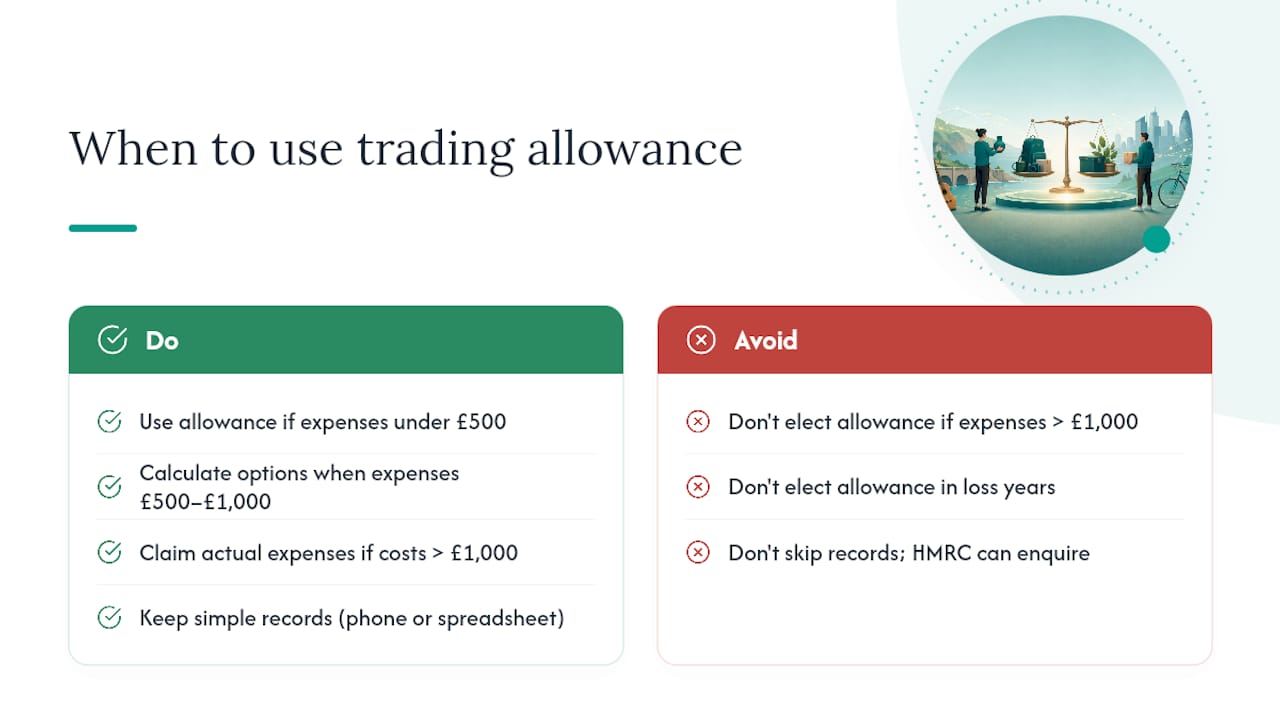
My practical rule of thumb: if your expenses are genuinely under £500, use the allowance without hesitation. Between £500 and £1,000, do the five-minute calculation. Above £1,000, always use actual expenses. And in any year where costs exceed income, do not touch the allowance.
Record minimalism is fine at low income levels, but keep something. A note in your phone, a simple spreadsheet, a folder of bank screenshots. HMRC can enquire up to four years back, and “I used the trading allowance” is not a defence if you cannot show your gross income was what you claimed. Ledgery’s receipt scanning and income tracking makes this genuinely painless for anyone already past the £1,000 threshold and heading toward Self Assessment.
Ledgery takes the admin out of Self Assessment for small earners
Once your trading income crosses £1,000, the record-keeping and filing obligations become real. Ledgery is built for exactly this situation: self-employed individuals and property owners who need to stay on top of their income and expenses without spending hours on it.
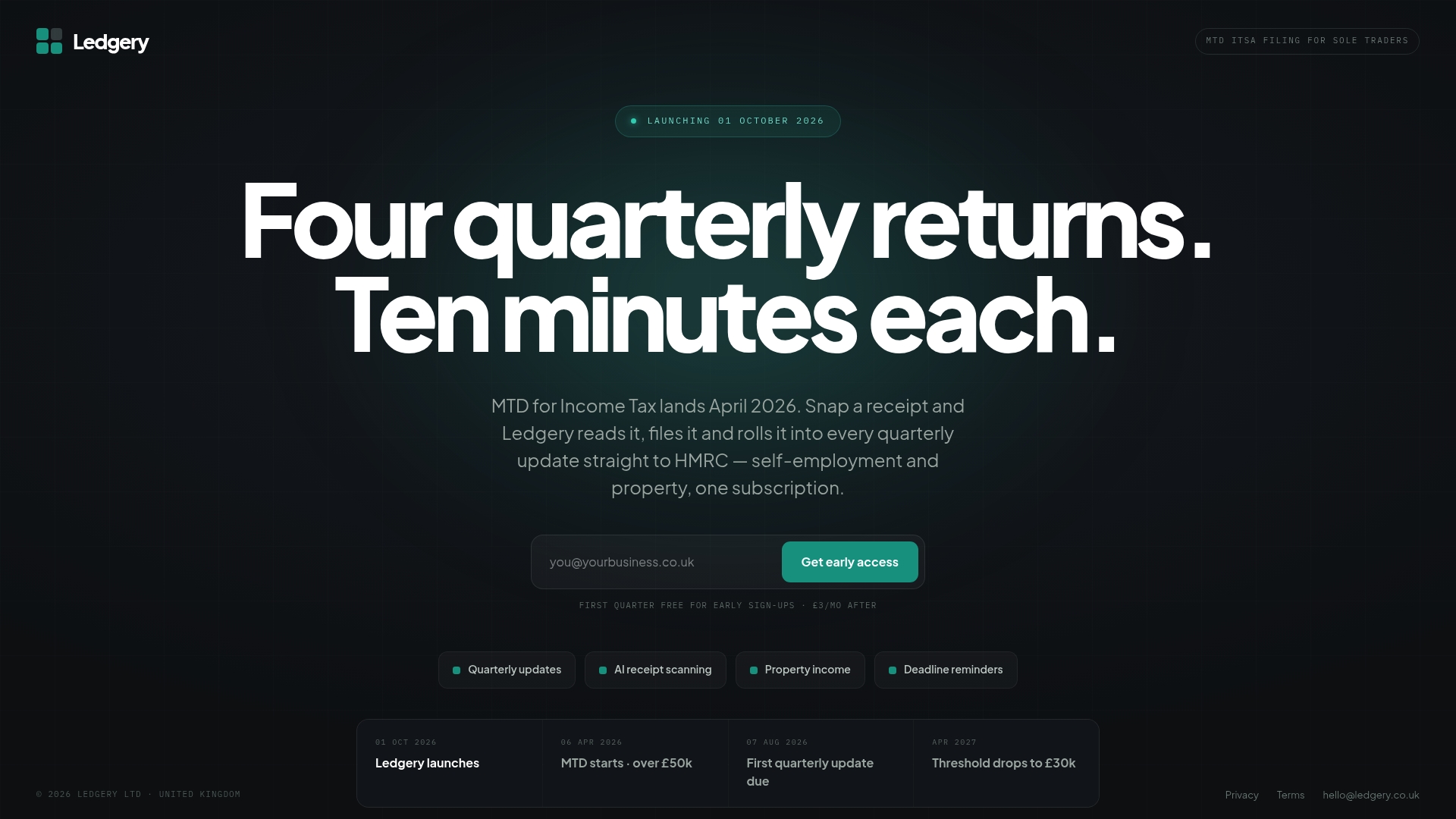
Snap a photo of a receipt and Ledgery logs it automatically. Your income and expenses are organised into quarterly HMRC-ready summaries, so when Self Assessment comes around you are not scrambling through a year’s worth of bank statements. Deadline alerts mean you will never miss the 5 October registration deadline or the 31 January filing date.
Features relevant to trading allowance users:
-
AI-powered receipt scanning and automatic expense categorisation
-
Simple income tracking across multiple trading activities
-
Quarterly update summaries ready for HMRC submission
-
Deadline reminders for Self Assessment registration and filing
The decision between using the trading allowance or actual expenses is up to the individual. Tools like Ledgery can help keep organised records to facilitate this choice. Ledgery and see how much simpler it gets.
The trading allowance is an individual tax election. Always compare your actual expenses against the £1,000 allowance before electing, and consider seeking advice from LITRG or TaxAid if you are unsure.
Sources
This article is general information, not a substitute for advice from a qualified financial advisor. Consult a qualified financial professional about your own circumstances before acting on anything here.
Recommended
Self-employment and property income in one subscription, first quarter free. Join the early access list and we’ll email you once, when it opens.
Join early access