No More EOPS: 4 Final Declaration Items UK Sole Traders & Landlords

The End of Period Statement no longer exists. HMRC removed it after the Making Tax Digital small business review, and the Final Declaration now serves as the year-end submission for sole traders and landlords. You still send quarterly updates throughout the year, but the EOPS step has gone. The Final Declaration deadline remains the 31 January following the end of the tax year.
TL;DR:
- The end of period statement has been permanently removed, simplifying the year-end process by consolidating all reports into one Final Declaration.
- The Final Declaration now combines quarterly updates, adjustments, and additional income, with the same January 31 deadline and payment rules as before.
- Digital record-keeping and accurate quarterly summaries are essential, with software like Ledgery streamlining receipt categorization and compliance.
- Landlords must separate property income from trade income from day one to avoid confusion during the Final Declaration process.
- Prioritizing consistent year-round digital records and avoiding last-minute calculations reduces stress and improves accuracy at year-end.
Table of Contents
- What the end of period statement was and why HMRC removed it
- What replaces EOPS: the Final Declaration and how it works
- What you must do now: quarterly updates, digital records and a year-end checklist
- How software and organised records simplify compliance
- Why removing EOPS helps busy taxpayers
- Ledgery: built for quarterly updates and the Final Declaration
- Sources
What the end of period statement was and why HMRC removed it
The End of Period Statement, usually shortened to EOPS, was originally built into Making Tax Digital for Income Tax as a per-income-source sign-off. If you had both a sole trade and rental property, you would have finalised each one separately before moving to a final submission. It was meant to confirm that the figures for that income source were complete and accurate for the tax year, ahead of any final adjustments.
HMRC scrapped it following feedback gathered during the Making Tax Digital small business review. Small businesses and agents pointed out that EOPS largely repeated work already covered by the Final Declaration, adding a step without adding value.
The rationale, in short:
- EOPS duplicated confirmations that the Final Declaration already required
- Agents and business owners flagged it as an unnecessary extra filing step
- HMRC’s own review concluded that removing it would simplify the year-end process without weakening the accuracy of submissions
The removal is permanent and applies from MTD mandation onward, so there is no version of the current system where EOPS reappears for affected taxpayers.
What replaces EOPS: the Final Declaration and how it works
The Final Declaration is now the single year-end submission. It pulls together everything you have already reported through your quarterly updates, then adds anything that could not be captured earlier: other income, reliefs, and any adjustments specific to the full tax year rather than a single quarter.
Under HMRC’s guidance on using Making Tax Digital for Income Tax, the Final Declaration typically needs to include:
- Confirmation of the totals from all four quarterly updates
- Year-end adjustments not suited to quarterly reporting, such as capital allowances or accruals
- Any additional income sources outside your MTD-reported trade or property business
- Claims for reliefs or allowances that apply to the tax year as a whole
The deadline is the 31 January following the end of the tax year, matching the existing Self Assessment filing date. Any balancing payment is due on the same date, and payments on account, along with the usual late filing and late payment penalty rules, continue to apply exactly as they did under Self Assessment. Nothing about the payment timeline has softened. It has simply been renamed and restructured around one final submission instead of two.
What you must do now: quarterly updates, digital records and a year-end checklist
Quarterly updates are summary totals, not detailed accounts. You report income and expenses for the quarter, but you are not expected to finalise adjustments there. That work now waits for the Final Declaration.
Pro Tip: Don’t try to squeeze capital allowances or accruals into a quarterly update just because the deadline is looming. Leave them for the Final Declaration, where they belong, and your quarterly figures stay clean and consistent.
Digital record-keeping remains a core MTD requirement throughout. Every transaction needs a digital trail, and HMRC maintains a list of compatible software that meets its technical standards. Using a recognised product avoids the manual re-entry that trips up a lot of self-employed filers.
A practical year-round checklist:
- Log income and expenses as they happen, not in an end-of-quarter scramble
- Submit quarterly updates on time and treat them as running totals, not final figures
- Save capital allowances, accruals and prepayments for the Final Declaration stage
- Track the quarterly reporting dates alongside the 31 January Final Declaration deadline
- If you’re a landlord, keep property income entirely separate from any sole trade income, and record allowable deductions such as mortgage interest relief, letting agent fees, and repairs as they occur
Landlords in particular benefit from splitting records by property from day one. Mixing rental and trading income in the same log is the single most common source of Final Declaration confusion.
How software and organised records simplify compliance
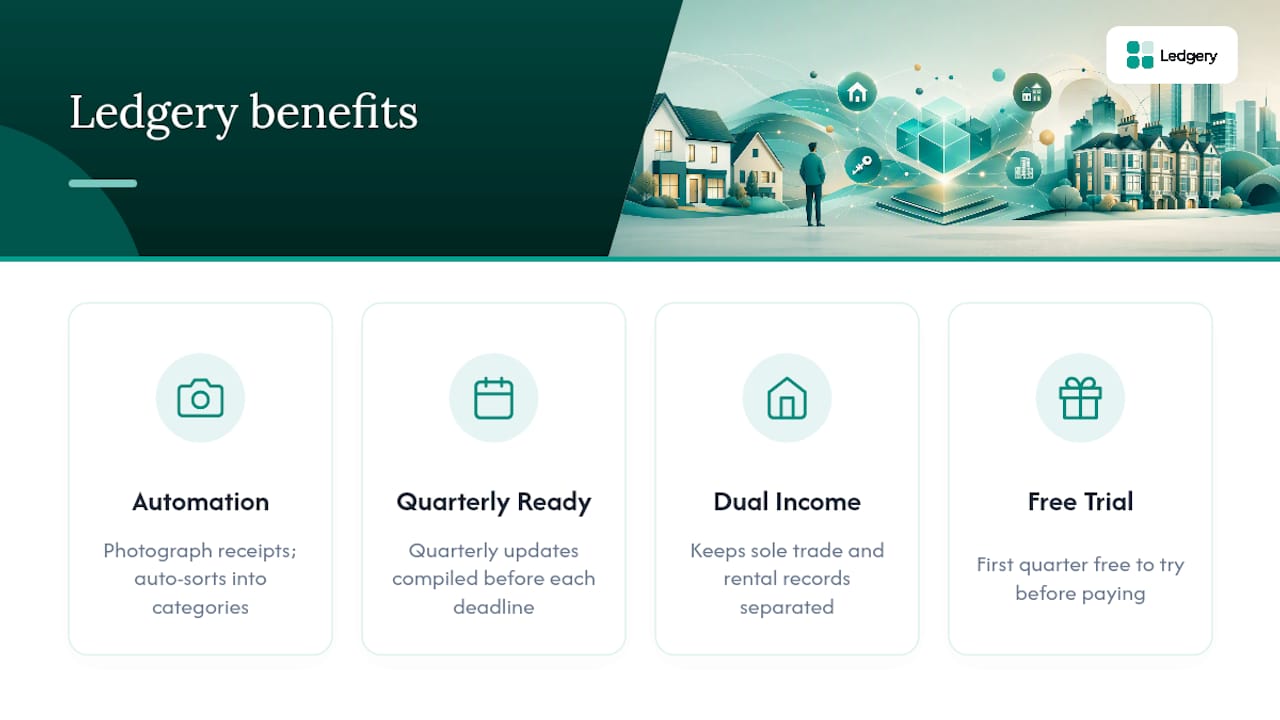
Manually sorting a year of receipts into the right categories is where most of the year-end stress actually comes from, not the filing itself. Ledgery approaches this by scanning receipts as you take them and matching each one to the correct expense category and income source automatically.
Ledgery’s role in this process centres on a few concrete steps:
- Photograph a receipt and it’s read, categorised and stored against the right income source
- Quarterly totals are compiled automatically and exported in HMRC-compatible formats
- Deadline alerts flag upcoming quarterly and Final Declaration dates before they become urgent
- Records stay organised year-round, so nothing needs reconstructing under pressure in January
The goal of a tool like this isn’t to remove your responsibility for the figures. It’s to make sure the figures you submit are the ones your receipts actually support.
Software of this kind helps you prepare accurate quarterly updates and a clean Final Declaration, but you remain responsible for the final accuracy of what gets submitted to HMRC. No product changes that.
Why removing EOPS helps busy taxpayers
Cutting EOPS was the right call. It asked taxpayers to confirm figures twice, once per income source and again at the Final Declaration, for no real gain in accuracy. Anyone juggling a sole trade and a rental property felt that duplication most acutely, filling out what was effectively the same confirmation from two different angles.
The practical takeaway is simple: keep your digital records tidy throughout the year and get your quarterly summaries right the first time. That single habit does more for your January stress levels than any amount of last-minute EOPS-style tidying ever did. If you haven’t moved to HMRC-compatible software yet, do it now rather than in the run-up to your first mandated quarter. The taxpayers who struggle most under MTD are the ones who treat digital record-keeping as a January problem instead of a year-round one.
— Jason
Ledgery: built for quarterly updates and the Final Declaration
Ledgery is the practical alternative to spreadsheets and shoebox receipts for sole traders and landlords facing MTD for Income Tax. Instead of reconstructing a year of expenses from memory, you photograph receipts as they happen, and Ledgery sorts them into the right categories and income sources automatically.
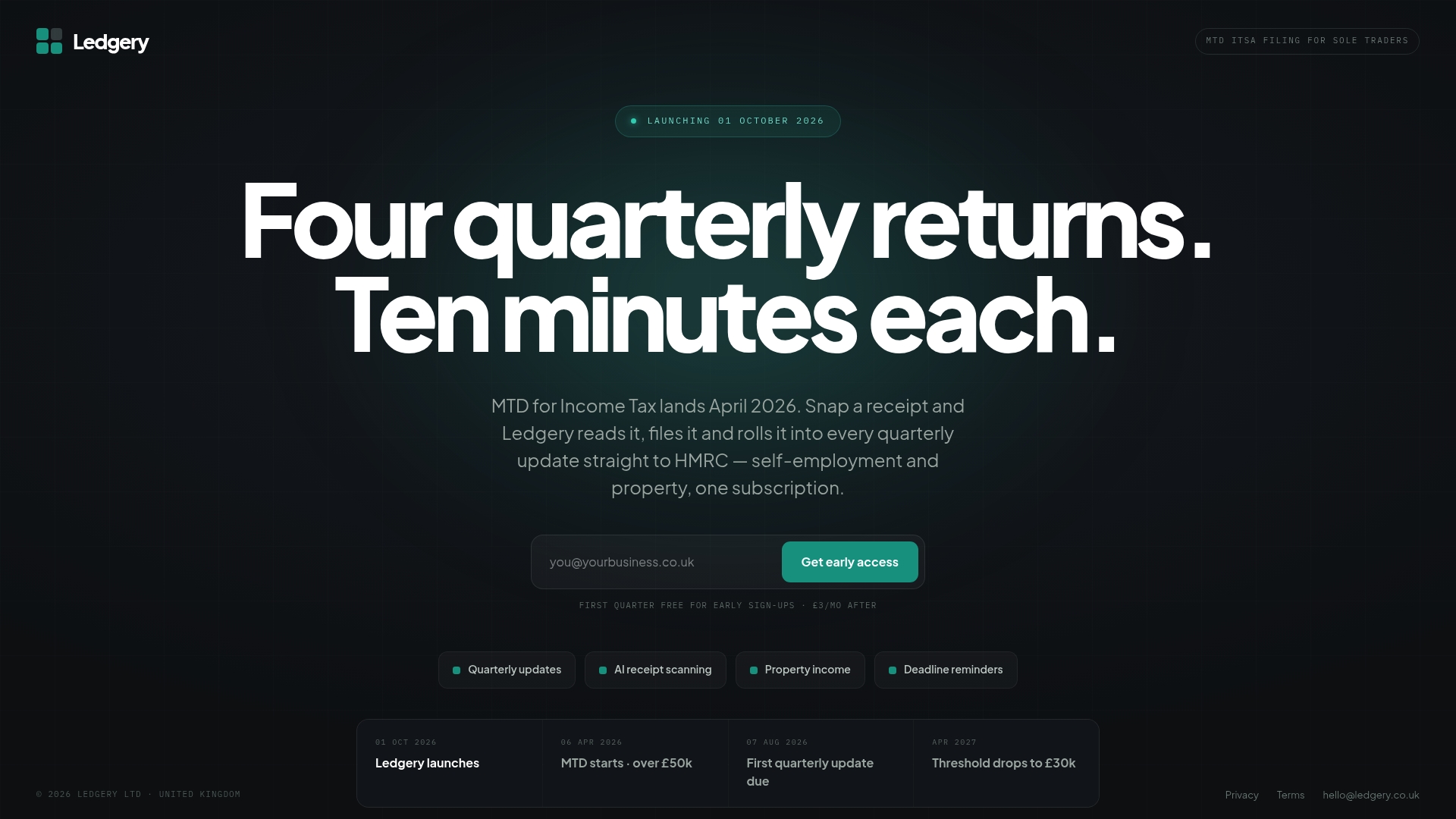
That means your quarterly updates are already compiled when the deadline arrives, and your Final Declaration figures are built from records you trust rather than ones you’re hoping are complete. Ledgery works for both sole trade and rental property income, keeping the two separated cleanly, which matters if you’re one of the many landlords juggling both. Deadline alerts flag your quarterly and Final Declaration dates ahead of time, and everything exports in a format ready for HMRC submission.
The first quarter is free, which gives you a genuine trial period to see whether it fits your routine before paying anything. It’s particularly worth it if your income sits above £50,000 and your reporting obligations are only going to get more demanding. Head to Ledgery to start your free first quarter and see your first automated summary before your next deadline lands.
Sources
For the primary source on the EOPS removal, read the Making Tax Digital small business review outcome directly from HMRC. For the mechanics of quarterly updates and the Final Declaration, HMRC’s own guidance on using Making Tax Digital for Income Tax is the definitive reference.
If you want more detail on the practical side, Ledgery’s guides cover quarterly update requirements, MTD obligations for landlords, and Self Assessment deadlines that still apply alongside the Final Declaration.
This article is general information, not a substitute for advice from a qualified financial advisor. Consult a qualified financial professional about your own circumstances before acting on anything here.
- Making tax digital small business review: outcome
Recommended
Self-employment and property income in one subscription, first quarter free. Join the early access list and we’ll email you once, when it opens.
Join early access