£50,000 MTD Threshold: Self Employed Tax Calculation UK 2026/27

Your total tax bill equals Income Tax on your taxable profit plus Class 4 National Insurance. Work out profit first (turnover minus allowable expenses), then apply the bands. Many sole traders should set aside a roughly quarter to a third of profit for tax. If your turnover is above £50,000, Making Tax Digital rules mean you’ll need digital records and compatible software.
TL;DR:
- The tax calculation depends on accurate profit measurement, which involves deducting allowable expenses from turnover, not work expenses or stock costs.
- Starting April 2026, sole traders earning over £50,000 must adopt Making Tax Digital for Income Tax, requiring digital records and quarterly submissions.
- Payments on account are due if the previous year’s tax exceeds £1,000, typically amounting to two installments of 50 percent, paid by January and July.
- Both cash basis and traditional accounting are options, but choosing where to record income and expenses impacts tax timing and record-keeping complexity.
Table of Contents
- How do you calculate self employed tax step by step?
- Worked examples: what do you actually owe?
- Do you need to use Making Tax Digital for Income Tax?
- When are payments on account due and how do you budget for them?
- Cash basis or traditional accounting: which suits you?
- What mistakes actually cost self employed people money?
- How Ledgery keeps your quarterly figures accurate
- Sources
How do you calculate self employed tax step by step?
Getting your self employed tax calculation right comes down to following the same order every time. Skip a step, or work from turnover instead of profit, and the whole figure comes out wrong.
- Work out turnover. Add up everything you were paid or invoiced for the tax year, before any costs come off.
- Subtract allowable expenses. This give you your taxable profit. If your turnover is under £1,000, you can use the trading allowance instead of itemising costs.
- Choose your accounting basis. Cash basis (money in, money out) or traditional accounting (accruals) changes when income and costs count, not just how you record them.
- Deduct the Personal Allowance. For 2026/27 that’s £12,570, applied before you calculate Income Tax.
- Apply the Income Tax bands slice by slice. 20% on profit from £12,571 to £50,270, 40% from £50,271 to £125,140, and 45% above that.
- Calculate Class 4 National Insurance on the same taxable profit: 6% between £12,570 and £50,270, 2% above that, and nothing at all if profit sits below £12,570, per the National Insurance rates.
- Add Income Tax and Class 4 NI together for your total liability, then set aside your tax pot from ongoing income rather than scrambling in January.
Pro Tip: Open a separate savings account purely for tax and transfer a fixed percentage every time you’re paid. It removes the guesswork and stops the tax pot getting spent on anything else.
Worked examples: what do you actually owe?
Numbers make this far less abstract than percentages on their own. Here’s how the maths plays out for two different profit levels.
Example A: £35,000 taxable profit
- Personal Allowance: £12,570 (no tax on this portion)
- Taxable at 20%: £22,430 × 20% = £4,486 Income Tax
- Class 4 NI: (£35,000 − £12,570) × 6% = £1,345.80
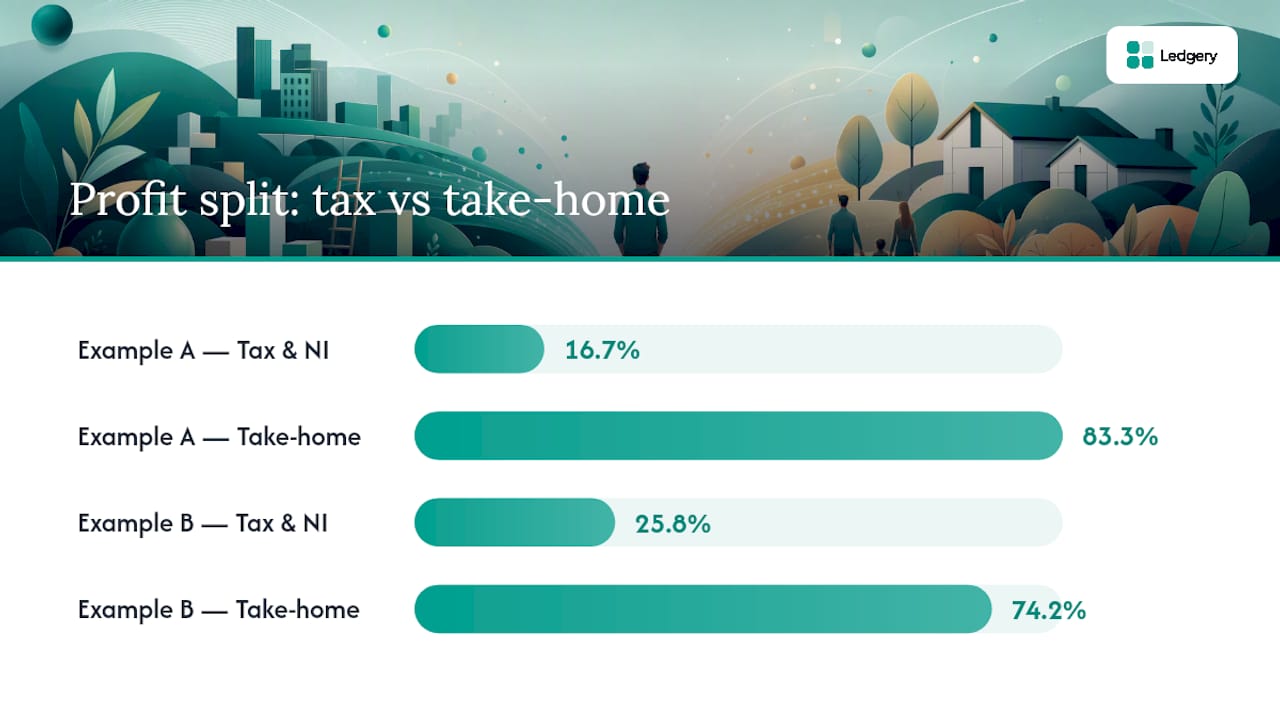
- Total tax and NI: £5,831.80 — take-home before other deductions: roughly £29,168
Example B: £70,000 taxable profit
- Basic rate band (£12,571–£50,270): £37,700 × 20% = £7,540
- Higher rate band (£50,271–£70,000): £19,730 × 40% = £7,892
- Income Tax total: £15,432
- Class 4 NI: (£50,270 − £12,570) × 6% = £2,262, plus (£70,000 − £50,270) × 2% = £394.60
- Total tax and NI: £18,088.60 — an effective rate of roughly 25.8% on profit
Between £100,000 and £125,140, the Personal Allowance shrinks by £1 for every £2 of profit above £100,000, disappearing entirely at £125,140.
The most common pitfall in both examples? Confusing turnover with profit. If you’ve spent £15,000 on stock, tools or subcontractors, that £15,000 never enters the tax calculation at all.
Do you need to use Making Tax Digital for Income Tax?
From 6 April 2026, sole traders with qualifying income over £50,000 must use Making Tax Digital for Income Tax, keeping digital records and sending quarterly updates rather than one annual return. Lower thresholds follow in later years, so it’s worth checking your position now even if you’re currently under £50,000.
Qualifying income means your total turnover from self-employment and property, calculated before expenses come off. That catches people out. A trader with turnover above the threshold qualifies, regardless of the profit after costs.
- Check your status using HMRC’s online eligibility tool.
- Sign up ahead of your first quarterly deadline once you know you qualify.
- Pick MTD compatible software rather than relying on spreadsheets alone.
- Keep digital receipts as you go. Our MTD guide for sole traders covers the sign-up process in more detail.
- Submit quarterly summaries roughly every three months, then a final declaration after the tax year ends.
When are payments on account due and how do you budget for them?
If your Self Assessment bill exceeds £1,000, HMRC usually asks for payments on account: two advance instalments, each 50% of the previous year’s tax bill.
- Register by 5 October in your business’s second tax year if you haven’t already.
- File your return and pay any balancing amount by 31 January, alongside your first payment on account.
- Pay the second instalment by 31 July.
- Set aside 25–30% of profit as you earn it, adjusting upward if you’re near the higher rate threshold.
- Budget extra in year one. First-time filers often pay a full year’s tax plus a 50% advance in the same January, which can double the bill unexpectedly.
Our guide to quarterly tax dates lists every deadline in one place if you’d rather not track them manually.
Cash basis or traditional accounting: which suits you?
Cash basis counts money when it actually lands in or leaves your bank account. Traditional accounting (accruals) counts income when you invoice it and costs when you incur them, regardless of when cash moves. HMRC guidance allows most sole traders to choose either, though cash basis has its own turnover limits.
- Cash basis suits traders who invoice and get paid quickly, since it’s simpler and closer to how your bank balance actually moves.
- Traditional accounting suits businesses with stock, work in progress, or long payment terms, where accruals gives a more accurate profit picture.
- Switching bases triggers one-off adjustments for debts owed to you, prepayments and capital allowances in the transition year, so expect some extra arithmetic that year only.
- Read our comparison of cash versus accruals accounting before you commit, since changing basis later isn’t always straightforward.
Whichever basis you pick, allowable expenses reduce your taxable profit either way. Our breakdown of allowable expenses for the self employed covers what you can and can’t claim.
What mistakes actually cost self employed people money?
The same errors turn up year after year. Traders quote turnover when asked about income, forgetting the tax bill is based on profit. Others let receipts pile up for months, then lose the paper ones entirely by the time they sit down to file. A surprising number simply forget payments on account exist until the January bill arrives twice the size they expected.
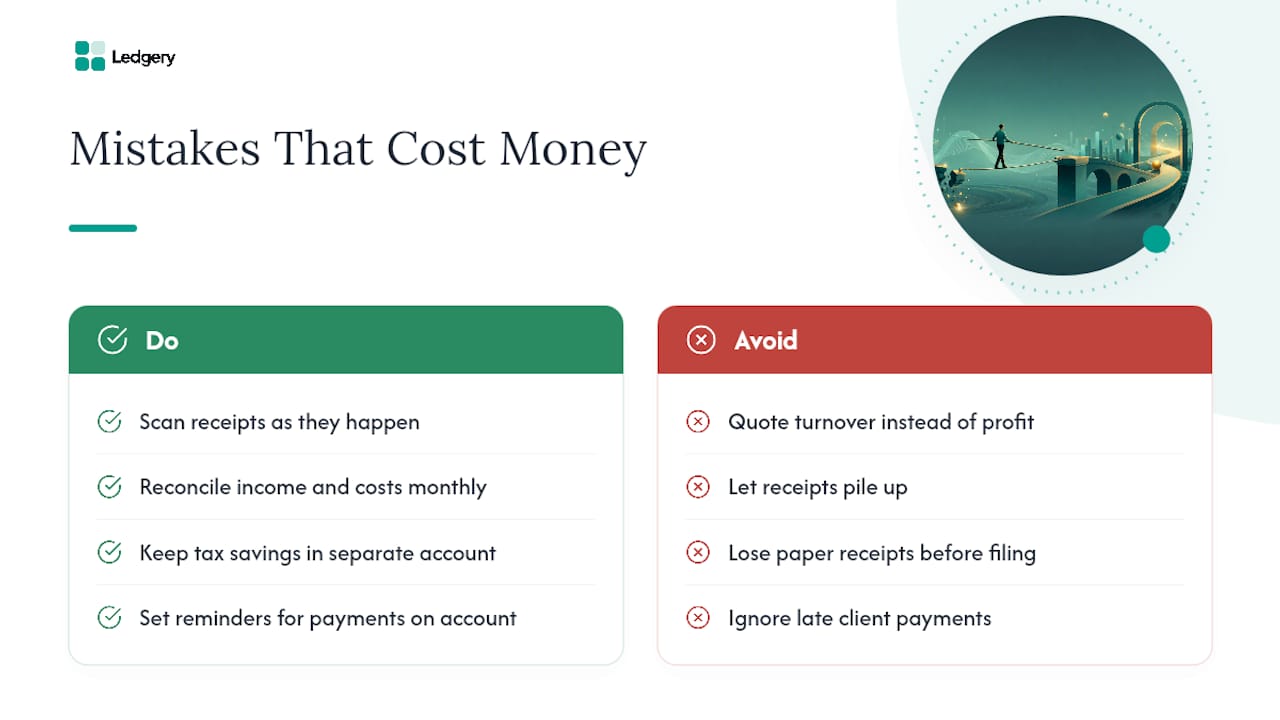
The fix isn’t complicated. Scan receipts as they happen rather than in a batch. Reconcile income and costs monthly instead of annually. Keep tax savings in a separate account you don’t touch for anything else. None of these habits demand accounting knowledge, just consistency, and consistency is what most late filers are missing when the deadline arrives.
Late payment also has a knock-on effect on your own invoicing. If clients pay you late, your turnover figures for the year can lag behind what you actually earned, distorting your calculation. The Debt Recovery Hub’s guide to late payment interest explains what you’re entitled to claim when a client drags out payment.
— Jason
How Ledgery keeps your quarterly figures accurate
Most of the errors above come down to one thing: receipts and records falling behind reality. Ledgery is built to close that gap. Snap a photo of a receipt and Ledgery organises it automatically into the quarterly summaries HMRC now expects under MTD, rather than leaving you to reconstruct months of spending from memory in January.
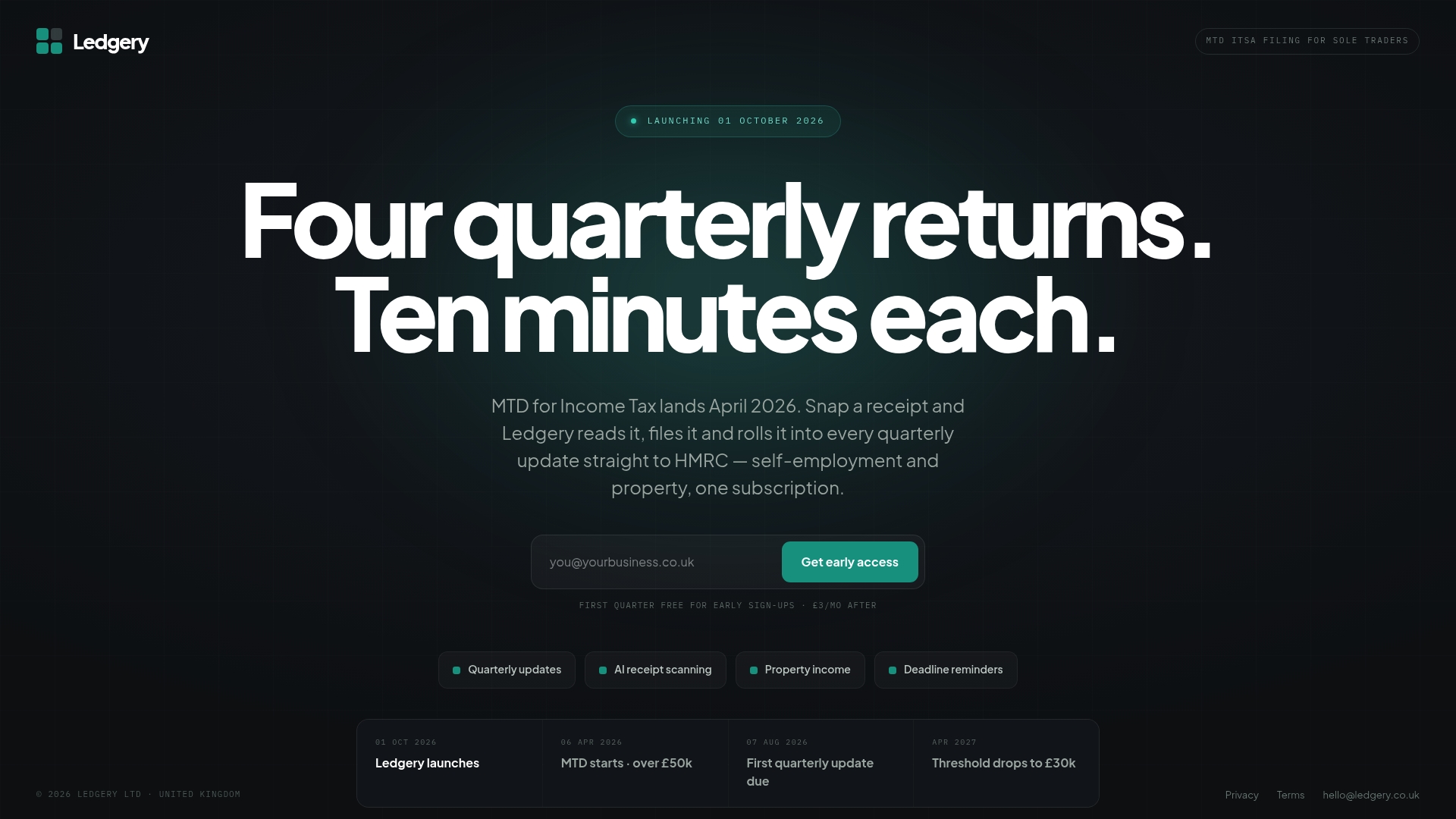
That matters most for anyone earning above £50,000, where quarterly digital reporting stops being optional. The software exports data in a format ready for HMRC submission, sends alerts ahead of each deadline, and starts with a free first quarter, so you can see how it fits your own record-keeping before committing to a subscription. If your turnover puts you inside the MTD threshold, or you’d simply rather not chase receipts every three months, set up your free first quarter with Ledgery and get your quarterly reporting sorted before your next deadline lands.
Sources
- Rates and allowances: Income Tax
- Rates and allowances: National Insurance contributions
- Extension of Making Tax Digital for income tax: guidance
Recommended
Self-employment and property income in one subscription, first quarter free. Join the early access list and we’ll email you once, when it opens.
Join early access