Self-Employed Tax Savings: Legitimate Ways to Pay Less in the UK

Most tax savings for the self-employed come from one source: lowering taxable profit by claiming every allowable cost and keeping the records to prove it. Income Tax and National Insurance are charged on profit, not on turnover, so each missed receipt costs money. Software that captures receipts as they occur and builds the quarterly updates under Making Tax Digital (MTD) keeps those savings from being lost. Ledgery is built for this: users photograph a receipt, and the figures are organised into the quarterly updates sent to HMRC.
TL;DR
- Tax is charged on profit. Allowable business costs reduce profit, so complete expense records reduce the bill.
- Profit of £50,000 produces roughly £9,700 of Income Tax and Class 4 National Insurance on 2025/26 figures, which is about 19% of profit.
- Sole traders with gross income of £1,000 or less pay no tax on it. Above that, they choose between the £1,000 trading allowance and actual expenses, never both.
- Between £100,000 and £125,140 of income, the marginal rate on self-employed profit reaches about 62%.
- MTD for Income Tax applies from 6 April 2026 to those with 2024/25 qualifying income over £50,000, so digital records now matter for people at that level.
Table of Contents
- How tax on self-employed profit is worked out
- What £50,000 of profit costs in tax
- Allowable expenses: the main saving
- The £1,000 trading allowance
- Property income and Rent-a-Room relief
- The 62% trap
- Setting money aside and payments on account
- Correcting past years: the four-year rule
- Making Tax Digital and why records now affect savings
- What Ledgery does for this
- Perspective
- FAQ
- Sources
How tax on self-employed profit is worked out
A sole trader adds up income, deducts allowable expenses and pays tax on what remains. GOV.UK gives a simple example: turnover of £40,000 less £10,000 of allowable expenses means tax is due on £30,000.
Two accounting methods exist. Under the cash basis, income counts when received and expenses when paid. Under traditional accounting, income and costs count when they are earned or incurred. HMRC’s HS222 helpsheet describes both. According to LITRG, the cash basis has been the default since 2024/25. Ledgery has a separate guide to cash versus accruals for sole traders.
Profits are taxed by tax year, which runs from 6 April to 5 April. This applies from 2023/24, after the basis period reform, according to the same LITRG page.
What £50,000 of profit costs in tax
The bands below are for England, Wales and Northern Ireland. Scotland sets its own Income Tax rates. MoneyHelper gives the 2026/27 figures:
| Income band | Rate |
|---|---|
| Up to £12,570 (Personal Allowance) | 0% |
| £12,571 to £50,270 | 20% |
| £50,271 to £125,140 | 40% |
| Above £125,140 | 45% |
The same page gives 2025/26 Class 4 National Insurance on profits: 6% between £12,570 and £50,270, and 2% above that. Class 2 is voluntary at £3.50 a week for lower profits, and nothing is due on profits between £6,845 and £12,569.
A worked example for profit of £50,000, using those figures:
| Item | Calculation | Amount |
|---|---|---|
| Income Tax | (£50,000 - £12,570) x 20% | £7,486.00 |
| Class 4 NI | (£50,000 - £12,570) x 6% | £2,245.80 |
| Total | £9,731.80 |
This is an illustration. It ignores other income, student loan repayments, pension contributions and Scottish rates. A person with a PAYE job and freelance income on top is taxed on the combined total, which can move the freelance profit into the 40% band.
The example also shows the point of record keeping. At the 20% band plus 6% Class 4, each extra £1,000 of allowable expense saves about £260. Above £50,270 the combined rate is 42%, so the same £1,000 saves about £420.
Allowable expenses: the main saving
GOV.UK lists the main categories a sole trader can deduct:
- office costs, such as stationery and phone or internet use for the business
- travel costs, including fuel and parking
- clothing needed for the job, such as uniforms
- staff costs and subcontractors
- stock and materials for resale
- insurance, bank charges and premises costs
- advertising and marketing
- trade subscriptions and training related to the business
The items most often missed are small and recurring. Examples are the business share of a mobile bill, card or account fees, software subscriptions and the cost of a work-only trip. Ledgery covers these in separate guides on mobile phone expenses and bank charges. Costs from before the first sale can count too, as set out in the guide to pre-trading expenses.
What cannot be claimed
HMRC’s HS222 helpsheet states that the private-use share of motoring, fines, client entertainment, ordinary clothing, and payments to clubs, charities and political parties are not allowable. Depreciation is never deductible, because capital allowances replace it. LITRG adds that personal expenses are never allowable. Mixed-use costs need splitting, and the guide to personal versus business expenses explains how. Keeping business money in its own account makes the split easier, as covered in the piece on a separate bank account for a sole trader.
Evidence
A return does not need proof attached. GOV.UK guidance says proof and records should be kept so they can be shown to HMRC if asked. A photographed receipt stored with its date, amount and category meets that need without a shoebox of paper.
The £1,000 trading allowance
HS222 states that gross receipts of £1,000 or less are exempt under the trading income allowance. Those with receipts above £1,000 can elect to deduct the allowance instead of actual expenses. GOV.UK states that expenses cannot be claimed if the allowance is used.
The choice is arithmetic. If actual allowable costs are below £1,000, the allowance saves more. If they are above £1,000, claiming real expenses saves more. A trader with £4,000 of receipts and £2,500 of costs is better off claiming the costs. The allowance and capital allowances for plant and machinery are among the adjustments that GOV.UK’s MTD guidance says can be made after the fourth quarterly update.
Property income and Rent-a-Room relief
The same MTD guidance states that Rent-a-Room relief lets a person earn up to £7,500 a year tax-free from furnished accommodation in their own home, halved if the income is shared. Landlords with let property keep separate records of rent and costs. Those who also assess investment returns on a property can use a guide to cash on cash return for UK property. Ledgery supports both self-employment and property income, but not limited companies or VAT.
The 62% trap
The 62% figure applies at higher incomes. MoneyHelper states that the Personal Allowance of £12,570 falls by £1 for every £2 of income above £100,000, and reaches zero at £125,140. In that band, each extra £1 of profit is taxed at 40%. The lost allowance adds a further £0.50 of income to tax at 40%, which is another 20 pence. Class 4 National Insurance adds 2%. The total is about 62% between £100,000 and £125,140, then it falls to 47% above that level (45% plus 2%).

A lower profit in this band is therefore worth far more than usual. Allowable expenses count in full. Pension contributions and Gift Aid donations can also reduce the income used for the allowance test, and Ledgery has a guide to Gift Aid for the self-employed. The limits on pension relief depend on personal circumstances, so those with profits in this band should speak to a pension provider or a regulated adviser before contributing.
The budget thresholds are not moving soon. GOV.UK’s Budget 2025 publication states that the Personal Allowance stays at £12,570 and the higher rate threshold at £50,270 for 2028/29 to 2030/31. The self-employed National Insurance limits of £12,570 and £50,270 are also maintained from April 2028 to April 2031.
Setting money aside and payments on account
Nobody deducts tax from self-employed income, so the money has to be put aside. Common guidance suggests a percentage of profit, and the £50,000 example above gives about 19%. Profit near or above £50,270 needs more.
Payments on account are advance payments towards the next bill. LITRG sets out the schedule: 50% of the previous year’s liability on 31 January during the tax year, another 50% on 31 July after it ends, and the balancing payment on the following 31 January, together with the first payment on account for the next year. A first-year trader can face the balancing payment and a first payment on account in the same January. That is a reason to reserve cash from the first invoice.
The Federation of Small Businesses key dates page adds that a new self-employed person must tell HMRC by 5 October after the end of the tax year in which the business started. Check the official GOV.UK pages for each year’s exact dates.
Correcting past years: the four-year rule
An overpayment can be claimed back. HMRC’s Self Assessment Claims Manual states that overpayment relief claims must be made within four years after the end of the relevant tax year. This covers a mistake in a return and other overpayments. A forgotten expense from a past year can therefore still be recovered if it is inside that window, provided the records exist.
Making Tax Digital and why records now affect savings
According to GOV.UK’s MTD toolkit, MTD for Income Tax starts on 6 April 2026 for people with 2024/25 qualifying income over £50,000. It starts on 6 April 2027 for those over £30,000 in 2025/26, and on 6 April 2028 for those over £20,000 in 2026/27.
Affected people keep digital records in compatible software, send four quarterly updates a year, then submit a tax return and pay by 31 January. The return is pre-filled with the quarterly figures and HMRC-held income. The same page says the points-based system gives a £200 penalty at four points, and that HMRC will not apply points for late quarterly updates in 2026/27.
Expenses logged late or not at all fall out of the quarterly figures, and so out of the claim. Capturing them when they occur is the practical saving.

What Ledgery does for this
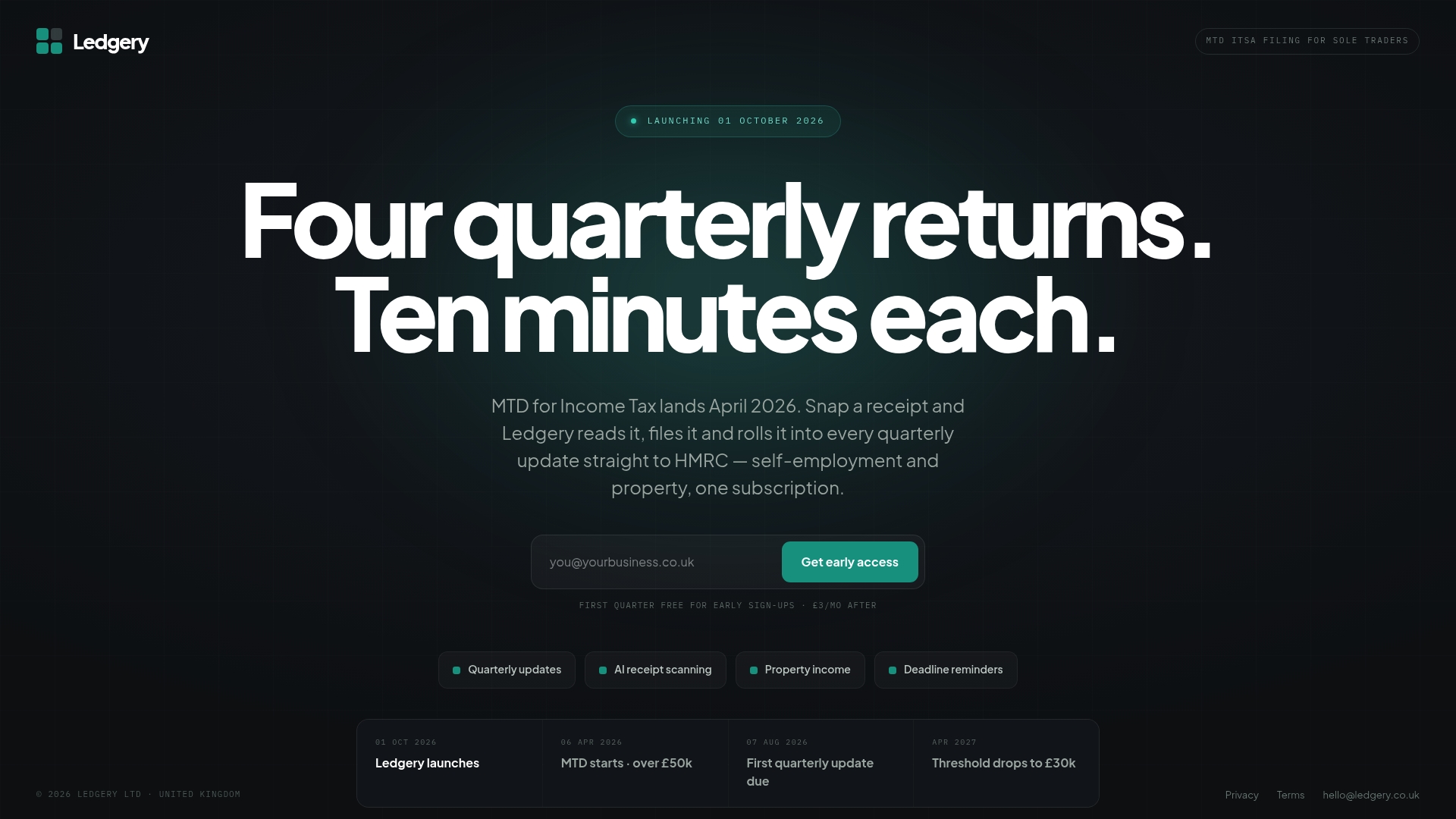
Ledgery is income tax management software for UK sole traders and property owners. Users photograph receipts, and AI-powered scanning records them. The platform generates quarterly HMRC updates, stores income and expense records, creates invoices, sends deadline reminders and exports data. Filing to HMRC stays under the user’s control, and accountants can be given access. Ledgery brings receipt scanning, Open Banking feeds, bookkeeping and tax filing for self-employment and property income into one platform.
The first quarter is free, then the subscription is monthly or annual across the Simple, Grow and Pro plans. See the plans on the Ledgery site.
Perspective
Tax savings for sole traders are rarely clever. They are the sum of many small, correct claims that were recorded on the day the cost arose.
We built Ledgery around that idea. A receipt photographed at the till is a receipt that exists at quarter end, and a quarterly update built from stored records needs no reconstruction. For those earning over £50,000, who are already inside MTD, this is the routine we aim to make short.
We also think records and filing belong together. When expenses, income, bank feeds and the quarterly update sit in one place, and an accountant can be given access, fewer items are missed and the person filing stays in control of what is sent.
The Ledgery Team
FAQ
What is the most overlooked self-employed deduction?
Small, regular costs are the usual gap: the business share of a phone bill, bank charges, software subscriptions and training. Each is listed as allowable by GOV.UK where it is wholly for business. Capturing receipts as they arise stops these from being forgotten.
How much tax is paid on £50,000 of self-employed profit?
On 2025/26 figures, with no other income, it is about £7,486 of Income Tax and £2,245.80 of Class 4 National Insurance, a total of £9,731.80. Other income, pension contributions or Scottish rates change the result.
What is the 62% tax trap?
It is the effective rate on profit between £100,000 and £125,140. The 40% rate, the loss of Personal Allowance and 2% Class 4 National Insurance combine to give about 62%. Reducing profit in this band saves more tax than elsewhere.
What is the four-year rule?
HMRC states that overpayment relief claims must be made within four years after the end of the tax year concerned. A missed expense or a mistake in a past return can be corrected within that period.
Sources
- Expenses if you’re self-employed, GOV.UK
- HS222 How to calculate your taxable profits (2026), GOV.UK
- Calculating self-employed profits, LITRG
- Tax and National Insurance for self-employed, MoneyHelper
- Help with self-employment on your Self Assessment tax return, GOV.UK
- Use Making Tax Digital for Income Tax: adjust your self-employment and property income, GOV.UK
- Budget 2025 overview of tax legislation and rates, GOV.UK
- Paying tax on self-employed profits and making payments on account, LITRG
- Key dates for small business owners in 2026, FSB
- SACM12155 Overpayment relief time limits, GOV.UK
- Understanding Making Tax Digital for Income Tax, GOV.UK
- Cash on Cash Return: How to Calculate It for UK Property
Recommended
Self-employment and property income in one subscription, 30 days free to start. Join the early access list and we’ll email you once, when it opens.
Join early access