Multiple Income Streams and Tax in the UK: How They Combine

Income from several sources is added together for UK income tax. Employment pay, self-employed profits, rental income, savings interest and dividends all count towards one Personal Allowance and one set of tax bands. Each type of income is taxed in a set order and at its own rates. People with self-employed or property income above certain levels must also keep digital records and send quarterly updates under Making Tax Digital for Income Tax (MTD). Ledgery is income tax software for UK sole traders and landlords. It turns photographed receipts into records and quarterly HMRC updates, which covers the record-keeping side of this topic.
TL;DR
- All taxable income from every source is added up against one Personal Allowance of £12,570 for 2026/27. It is not given again for each job or business.
- Income is taxed in order: wages, profits and rent first, then savings interest, then dividends. Each type has its own rates.
- The first £1,000 of trading income and the first £1,000 of property income can be tax-free, but records of income are still needed.
- Combined gross income from self-employment and property over £50,000 brings MTD from April 2026. The limit falls to £30,000 in April 2027 and £20,000 in April 2028.
- Income and expenses need to be recorded separately for each type of income.
Table of Contents
- How HMRC combines different income types
- Rates and allowances for 2026/27
- The order in which income is taxed
- The trading and property allowances
- Jobs, pensions and tax codes
- When registration for Self Assessment is needed
- Making Tax Digital for people with several streams
- Records for each stream
- How Ledgery handles the record-keeping
- Perspective
- FAQ
- Sources
How HMRC combines different income types
HMRC does not tax each income stream on its own. The test on GOV.UK is to add up all taxable income, work out the tax-free allowances, and subtract them. If anything is left, tax is due. If nothing is left, no tax should be paid and a refund may be due.
GOV.UK lists what counts as taxable. Income Tax applies to employment earnings, self-employed profits, most pensions, rental income, some state benefits, trust income and savings interest above the savings allowance. The same page lists what is not taxed: the first £1,000 of self-employment income, the first £1,000 of rental property income, income from ISAs and National Savings Certificates, dividends within the dividend allowance, and Premium Bond or National Lottery wins.
A simple example shows the effect. Someone earns £30,000 from a job and £15,000 in profit from freelance work. Tax is not worked out on each amount separately. Both are non-savings income and are added together to £45,000. The Personal Allowance is taken off once, and the rest is taxed at the rates described below.
The same logic applies to other combinations. A landlord with a part-time job, a sole trader with a pension, or a freelancer with a rental flat and some savings all have one total, with allowances applied to it.
Rates and allowances for 2026/27
The GOV.UK rates page gives the figures for 2026/27. The Personal Allowance is £12,570. It reduces by £1 for every £2 of adjusted net income over £100,000 and reaches zero at £125,140. The basic rate is 20% on income from £12,571 to £50,270. The higher rate is 40% from £50,271 to £125,140. The additional rate is 45% above £125,140.

The House of Commons Library confirms that the rates and thresholds are unchanged from 2025/26, and that the Personal Allowance has been frozen at £12,570 since April 2022 and is due to stay there until April 2031. Married couples and civil partners may be able to transfer part of an unused allowance through the marriage allowance.
Two regional points matter. The Low Incomes Tax Reform Group notes that Scottish taxpayers pay six Scottish rates on non-savings income, while taxpayers in Wales and England pay three. It also gives the 2026/27 basic rate band as £37,700, which is the width of the 20% band above the Personal Allowance.
The £100,000 to £125,140 range
People with several income streams reach this range more easily than those with one salary. Because the allowance is withdrawn at £1 for every £2 over £100,000, income in that range carries an effective marginal rate higher than 40%. Adding a side business or rental profit to a salary near £100,000 is where the combined total needs the most attention.
The order in which income is taxed
The type of income decides which rate applies. The Low Incomes Tax Reform Group explains that non-savings, non-dividend income is taxed first, savings income second and dividend income third. Non-savings income covers wages, pensions, self-employment profits, rental income and taxable benefits.
The same source states that from 6 April 2027 property income will be taxed after other non-savings income but before savings and dividends, with its own rates. Landlords with other income should expect their tax calculation to change from that date.
The HMRC notes for the Self Assessment tax calculation set out the rates for 2025/26. Non-savings income is charged at 20% on the first £37,700, 40% on the next £32,700 and 45% on the rest. Savings income has a nil rate on the first £1,000, £500 or £0 depending on the taxpayer’s band, then the same 20%, 40% and 45%. Dividends have a nil rate on the first £500, then 8.75%, 33.75% and 39.35%.
In practice, wages and self-employed profit use up the Personal Allowance first. Savings interest and dividends are then layered on top, so they are more likely to fall into higher bands. A freelancer with £48,000 of profit and £3,000 of dividends will see the dividends taxed at a higher dividend rate than someone with the same dividends and no other income.
The Tax Confident campaign page adds that up to £5,000 of savings interest can be tax-free under the starting rate for savings when other income is low, and that the dividend allowance is £500, separate from the savings allowances. ISA interest is tax-free and does not count towards the savings allowances.
The trading and property allowances
Two allowances matter most for people who earn on the side. GOV.UK’s guidance on tax-free allowances on property and trading income covers both. Each is £1,000 a year, one for gross trading income and one for gross property income.
Gross means before expenses. A person with £900 of freelance receipts is under the trading allowance and generally has nothing to report on that income. A person with £4,000 of receipts can either deduct the allowance or deduct actual expenses. Actual expenses are better when they exceed £1,000. The allowance is better when they do not.
The choice has a cost. HMRC’s helpsheet on other taxable income states that if the £1,000 allowance is claimed, expenses cannot also be deducted and a loss cannot be created. The two cannot be combined on the same income.
Miscellaneous income
Miscellaneous income means casual earnings, commission and one-off freelance work that is not a regular trade. The same helpsheet explains that receipts of £1,000 or less from self-employment and miscellaneous income are exempt and need not be reported. Above £1,000, the amount goes on the tax return, and the allowance can be claimed instead of expenses. Losses on one type of other income can only be carried forward against income of the same type in later years.
Other kinds of income
Income from newer sources is also part of the total. Yield from crypto holdings is one example, and a guide to crypto income for professionals sets out how such income is generated. Whatever the source, it should be recorded with its date and amount so it can be classified correctly when the return is prepared.
Jobs, pensions and tax codes
A Personal Allowance is given once per tax year, not once per income. GOV.UK’s guidance on how tax works with more than one job says the allowance is usually allocated to the job that pays the most. A second job or pension will usually use a code such as BR, D0 or D1, depending on total income. These codes tax all pay at the basic, higher or additional rate with no allowance.
Tax codes depend on the total income across all sources. If the figures given to HMRC are wrong, too much or too little tax is collected. After the tax year, HMRC checks the tax paid across the jobs and may issue a P800 if the amount was wrong. A P800 is a calculation that shows a refund or a balance to pay.
Self-employed income does not go through a tax code in the same way. It is reported on a Self Assessment return, and the tax due is calculated there with the employment income included.
When registration for Self Assessment is needed
The rules depend on the type and amount of income. GOV.UK states that registration is needed if gross trading income is over £1,000, or other gross income is over £2,500. Registration must be done by 5 October after the end of the tax year in which gross income went over £1,000.
Registration is also needed at £1,000 or less in some cases: to claim loss relief, to pay voluntary Class 2 National Insurance, or to claim Tax Free Childcare or Maternity Allowance based on self-employment.
Employees who start a side business often miss this point. The business income can be small, and the job can already be taxed through PAYE, yet the side income still needs to be reported once it passes the limit.
Making Tax Digital for people with several streams
MTD changes how self-employed and property income is reported. ICAEW’s guidance explains that individuals with combined gross income from sole trades and property over £50,000 must join from April 2026. The limit falls to £30,000 from April 2027 and £20,000 from April 2028.
Four details of the test matter for anyone with more than one stream:
- It uses gross income, not profit.
- Sole trade and property income are added together.
- It is applied to each person individually.
- Income wholly covered by the trading allowance, property allowance or Rent a Room relief is excluded, and so is partnership income.
A freelancer with £35,000 of sales and a landlord with £20,000 of rent can pass the £50,000 limit by adding the two, even though neither stream does on its own. Employment income does not count towards the MTD test, so a salary does not push anyone over the threshold.
Under MTD, digital records are kept and quarterly updates are sent through compatible software. The details of how records must be linked are in the Ledgery guide to MTD digital links. The choice of accounting basis also affects the figures, and the guide on cash vs accruals explains it for sole traders.

Records for each stream
The rule that causes most mistakes is also the simplest. Records are kept separately for each type of income. The HMRC helpsheet requires income and expenses to be recorded separately for each type of other income.
GOV.UK says that when the trading or property allowance is used, records of income must still be kept. Accepted examples include invoices, a spreadsheet of receipts, emails confirming income, payer statements, bank statements, deposit records and a diary showing income from each customer. HMRC can penalise records that are inaccurate, incomplete, unreadable or not kept for the required period.
A workable routine for several streams looks like this:
- Give each stream its own record: employment, each business, each rental property, savings and dividends.
- Record every receipt and payment on the day it happens, or as close to it as possible.
- Mark each expense as business or personal. The guide to personal vs business expenses shows where the line sits for sole traders.
- Reconcile the records to bank statements each quarter.
- Keep the records for the period HMRC requires.
Mixing streams is the usual failure. A laptop bought for freelance work and a repair bill for a rental flat belong to different sources, and each loss or deduction can only be used against its own stream.
How Ledgery handles the record-keeping
Ledgery is built for UK sole traders and property owners. Users photograph a receipt, and the receipt scanning organises it into records. Those records are turned into the quarterly updates sent to HMRC. The software also stores income and expense records, creates invoices, sends deadline reminders and exports data. It covers sole trader and property income. It does not cover limited companies or VAT.
The first quarter is free, after which a monthly or annual subscription applies. Plans are Simple, Grow and Pro, and details are on the Ledgery site.
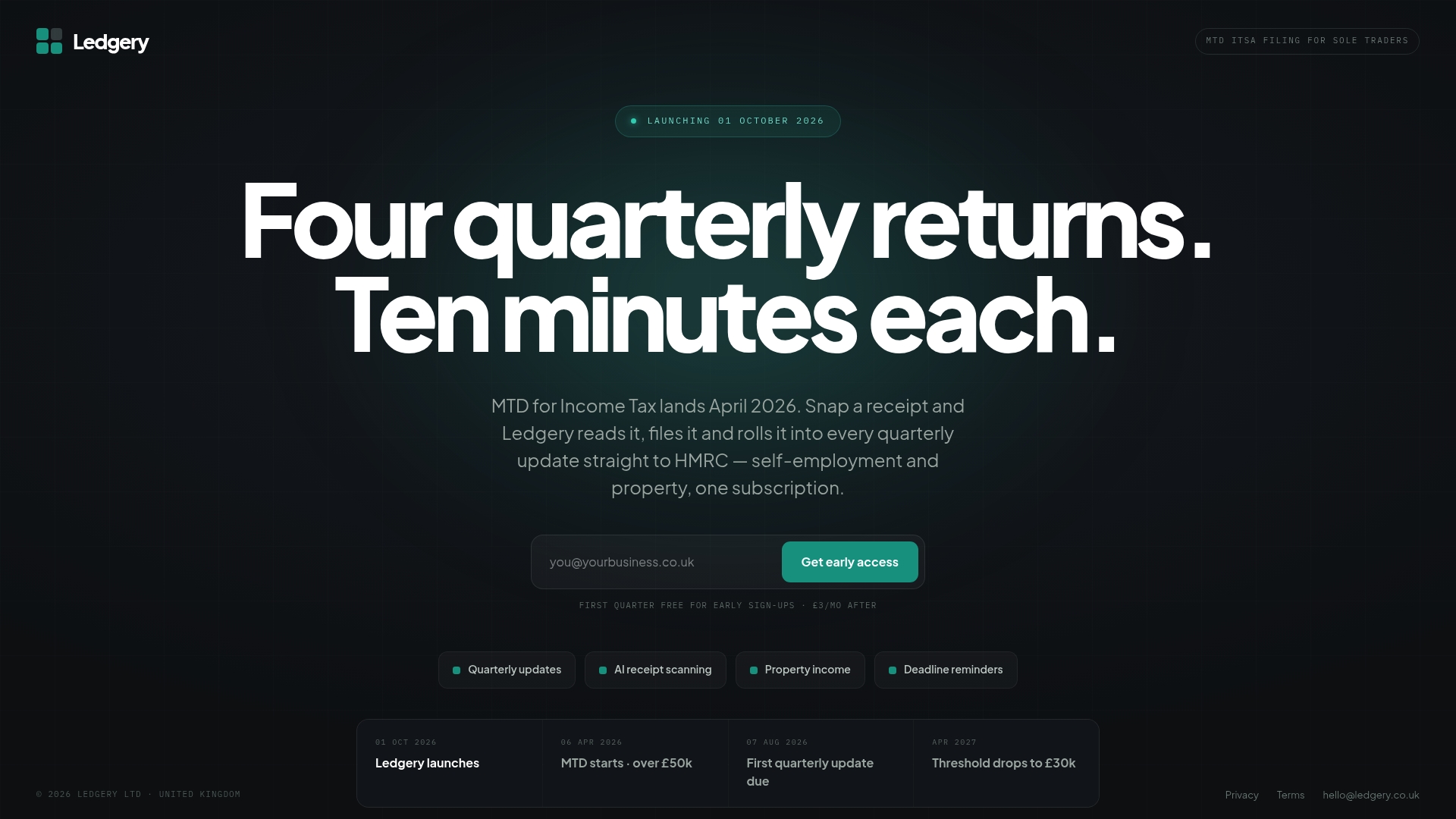
For people close to the MTD thresholds, the records for each stream are the part that takes the most time. Ledgery handles that part and the quarterly updates that follow from it.
Perspective
Most of the trouble with several income streams comes from records, not from rates. The rates are published and do not change often. What goes wrong is a receipt that cannot be found, an expense put against the wrong income, or a quarter that was not sent on time.
We built Ledgery for people in that position. A sole trader with a rental flat should not need two systems, so the platform brings bookkeeping, receipt scanning, Open Banking feeds and tax filing for self-employment and property income into one place. Records can be moved between plans as a business grows, and accountants can be given access.
Filing stays under the user’s control. Ledgery prepares the quarterly figures, and the user decides when they go to HMRC. With the MTD thresholds falling to £30,000 and then £20,000, more people will need digital records. Starting early gives time to build a clean record for each stream before it becomes a requirement.
The Ledgery Team
FAQ
Is income from a second job taxed differently from the first?
The tax rates are the same, but the Personal Allowance is usually given against the highest-paying job. The second job is typically taxed with a code such as BR, so all of its pay is taxed at the basic rate or above. HMRC reviews the total after the tax year and may issue a P800 if the amount was wrong.
Does side income under £1,000 need to be reported?
Generally no. The trading allowance means the first £1,000 of gross self-employment income is not taxed, and receipts of £1,000 or less need not be reported. Records of the income should still be kept. Registration for Self Assessment may still be needed for reasons such as claiming loss relief or paying voluntary Class 2 National Insurance.
Do employment earnings count towards the MTD threshold?
No. The threshold is based on combined gross income from self-employment and property, tested against the relevant earlier tax return. Salary, dividends and savings interest are not part of that test. Income covered by the trading allowance, property allowance or Rent a Room relief is also excluded.
Are dividends and savings interest taxed like wages?
No. Savings income and dividends are taxed after wages, profits and rent, and each has its own tax-free amount and rates. The dividend allowance is £500, and dividend rates are 8.75%, 33.75% and 39.35% in 2025/26 according to HMRC’s notes. ISA interest and dividends held in an ISA are not taxed.
Sources
- Income Tax: introduction, GOV.UK
- Work out if you need to pay Income Tax, GOV.UK
- Income Tax rates and Personal Allowances, GOV.UK
- Direct taxes: Rates and allowances for 2026/27, House of Commons Library
- Income tax, Low Incomes Tax Reform Group
- Tax Calculation Summary notes 2025-26, HMRC
- Tax on savings and investments in retirement, Tax Confident
- Tax-free allowances on property and trading income, GOV.UK
- Other taxable income (HS325), GOV.UK
- How tax works if you have more than one job, GOV.UK
- TAXguide 04/25: Making Tax Digital for income tax, ICAEW
- Crypto income for professionals
Recommended
Self-employment and property income in one subscription, 30 days free to start. Join the early access list and we’ll email you once, when it opens.
Join early access