HMRC record retention: Filing rules for UK self employed and landlords

Individuals who are not running a business must keep tax records for 22 months from the end of the tax year. The self-employed and partnerships keep them for 5 years from the 31 January after the tax year, and companies keep them for 6 years from the end of their accounting period. Miss the filing deadline and the rule becomes 15 months from the date you actually submit. If HMRC opens an enquiry, you keep everything until it closes, and scanned copies are accepted as long as they are complete and legible.
TL;DR:
- Self-employed and partnership records must be kept for five years from January 31 following the tax year, but late filings extend this to 15 months from submission.
- HMRC expects detailed, traceable documentation for income, expenses, payroll, assets, and property-related transactions, not just simple receipts.
- Electronic records are acceptable if complete, legible, and retrievable, with backups stored securely and files named systematically for quick access.
- Lost or stolen records require immediate action, reconstruction from bank statements or receipts, and clear logs to avoid penalties or extended enquiry scope.
- Businesses that cease trading or deregister for VAT still need to retain records for the statutory periods, with the clock starting from their last filing or period end.
Table of Contents
- HMRC record retention periods at a glance
- What records does HMRC actually expect you to keep?
- How do the timings differ for the self-employed, landlords, companies and VAT?
- What makes an electronic record acceptable to HMRC?
- What should you do if records are lost, stolen or destroyed?
- What happens if your records aren’t good enough for HMRC?
- A practical checklist for staying on top of retention
- Do different industries face different retention rules?
- How should you store records securely under data protection rules?
- How do you hand over records to a new accountant or new owner?
- What happens to your records when you stop trading or deregister for VAT?
- Why record-keeping habits matter more than the rules themselves
- A simpler way to capture what HMRC expects
- Where to check the official guidance
- Sources
HMRC record retention periods at a glance
The retention period you follow depends on who you are and how the tax return was filed. The table below sets out the core periods HMRC applies to the most common taxpayer categories.
| Taxpayer type | Retention period | Counted from |
|---|---|---|
| Individual (non-business) | 22 months | End of the tax year |
| Self-employed / partnership | 5 years | 31 January after the tax year |
| Company (Corporation Tax) | 6 years | End of the accounting period |
| VAT-registered business | Typically 6 years | Relevant VAT period |
| PAYE records | As required by HMRC | Relevant tax year |
| Late-filed return | 15 months minimum | Date of actual submission |
If a Self Assessment deadline is missed, the 15-month rule from actual submission overrides the standard 5-year clock, and it’s whichever period ends later that governs. HMRC’s own internal guidance defaults to a “6 years plus the current year” retention standard for many of its own public-sector records, which is worth knowing because it explains why 6 years, not 5 or 7, keeps recurring across HMRC’s corporation tax manual. If an enquiry is opened before your normal retention period ends, the clock effectively pauses. You keep the records until that enquiry is formally closed, regardless of what the calendar says.
What records does HMRC actually expect you to keep?
HMRC doesn’t ask for a vague sense of your income and spending. It expects a documented trail that a stranger could follow and reach the same figures you put on your return. That means:
- Sales and income proof: invoices issued, till rolls, online marketplace statements, and bank statements showing money coming in.
- Expense evidence: supplier invoices, till receipts, mileage logs with dates and purpose, and subsistence records for business travel.
- Payroll and employee files: payslips, P60s, and PAYE submission reports if you employ anyone.
- Asset and capital records: purchase and sale documentation for anything that might trigger a capital gain or loss, including dates and prices.
- Landlord-specific records: tenancy agreements, rent statements, and invoices for repairs or improvements to the property.
That last category matters more than most landlords realise. HMRC’s compliance manual treats letting property as a trade for record-keeping purposes, which means the same rigour applied to a sole trader’s books applies to a landlord’s rental accounts too. A receipt alone rarely satisfies HMRC. Inspectors want to see why an expense relates to the rental activity, not just that money changed hands. Our guide to landlord allowable expenses breaks down which receipts justify which claims.
How do the timings differ for the self-employed, landlords, companies and VAT?
The 5-year and 6-year figures sound simple until you apply them to a real filing calendar, where the start date shifts depending on your situation.
- Self-employed and partnerships: keep records for 5 years from the 31 January following the tax year. File your 2024–25 return by 31 January 2026, and you keep those records until at least 31 January 2031.
- Individuals with no business income: keep records for 22 months from the end of the tax year, a considerably shorter window than the self-employed face.
- Companies: keep records for 6 years from the end of the accounting period under CH14600, though a late return, an enquiry, or a claim spanning multiple years can extend this well beyond six years.
- VAT-registered businesses: typically follow a 6-year retention rule for VAT records, aligning closely with company retention but assessed against VAT periods rather than accounting periods.
- PAYE: employers keep payroll records for the period HMRC specifies, usually running in step with the tax years the payroll data covers.
- Late submissions and enquiries: filing late resets your minimum retention to 15 months from the actual submission date, and an open enquiry suspends the clock entirely until HMRC confirms it’s finished.
Landlords sit in an odd middle ground here. They’re rarely “companies” for tax purposes, yet HMRC still expects business-standard documentation, so the self-employed 5-year rule is the safer benchmark to apply.
What makes an electronic record acceptable to HMRC?
HMRC accepts electronic copies as long as they are complete, legible, and an accurate reproduction of the original document, according to its general guidance on keeping records for tax returns. That covers most receipts, invoices, and bank statements you might photograph or scan. A handful of documents, including certain certificates and tax vouchers, still need the physical original retained, so it’s worth checking before you shred anything unusual.
Beyond format, HMRC cares about whether you can actually retrieve and explain a record years later. A backup that exists but can’t be searched isn’t much use in an enquiry.
Pro Tip: Name files consistently, something like “2025-03-Invoice-SupplierName”, and keep them in folders organised by tax year rather than by month. It turns a five-year-old enquiry request from a scavenger hunt into a five-minute task.
Keep at least one backup copy stored separately from your main device, and avoid formats that can be edited after the fact where possible, since an audit trail showing when a record was created carries weight if HMRC questions its authenticity.
What should you do if records are lost, stolen or destroyed?
Losing records doesn’t automatically create a penalty, but ignoring the gap does. Act in this order:
- Notify relevant parties immediately, including your bank, suppliers, and any relevant insurer if theft or fire is involved.
- Rebuild what you can, using bank statements, supplier copies, and online transaction histories to reconstruct the missing figures.
- Keep a written reconstruction log noting what was lost, how, and what evidence you used to rebuild each figure.
- File using provisional figures if the deadline arrives before reconstruction is finished, and tell HMRC explicitly that estimates were used.
- Update HMRC with actual figures once you have them, replacing every estimate you originally submitted.
Bank statements tend to be the most persuasive replacement evidence HMRC will accept, since they’re independently verified and time stamped.
What happens if your records aren’t good enough for HMRC?
HMRC can charge penalties for failing to keep or preserve adequate records to support a tax return, under its enquiry manual guidance.
That figure is a ceiling, not a starting point. In practice, penalties at that level are reserved for serious or deliberate failures, not for a single missing receipt. A more common consequence is that poor records widen the scope of an enquiry, because HMRC has less to work with and more reason to question every figure on the return.
Demonstrating that you tried, kept a reconstruction log where something went missing, and can explain your methodology, tends to soften how HMRC treats the case. Our breakdown of Self Assessment penalties covers how mitigation typically works in practice.
A practical checklist for staying on top of retention
A workable system beats a perfect one you never maintain. Try this routine:
- Capture receipts weekly, not at year end, using photos or scans filed straight into a dated folder.
- Reconcile bank statements monthly against what you’ve recorded, catching gaps while memory is fresh.
- Tag every record by tax year and type the moment it’s filed, so retrieval later doesn’t depend on remembering context.
- Mark folders with a scheduled destruction date based on the relevant retention period, and review annually before deleting anything.
- Apply the longest applicable period whenever more than one rule could apply, a principle HMRC’s own internal manual recommends when regimes overlap.
A basic spreadsheet, a labelled filing cabinet, or dedicated receipt-scanning software can all meet HMRC’s standard. What matters is consistency, not the tool.
Do different industries face different retention rules?
The headline periods (22 months, 5 years, 6 years) apply across nearly every sector, but the type of evidence HMRC expects to see shifts depending on what your business actually does. A construction subcontractor under the Construction Industry Scheme needs to retain CIS deduction statements alongside standard invoices, because HMRC cross-checks these against contractor returns. Retailers handling significant cash need till rolls and Z-readings retained with the same rigour as bank statements, since cash businesses attract closer scrutiny by default.
Businesses trading in stock, whether that’s a shop, a wholesaler, or an online seller, need to keep records of stock valuations at the start and end of each accounting period, not just purchase invoices. This matters for calculating cost of sales accurately. Anyone importing or exporting goods needs customs declarations and duty records retained separately, often for longer than the standard tax-related period if a customs authority requires it.
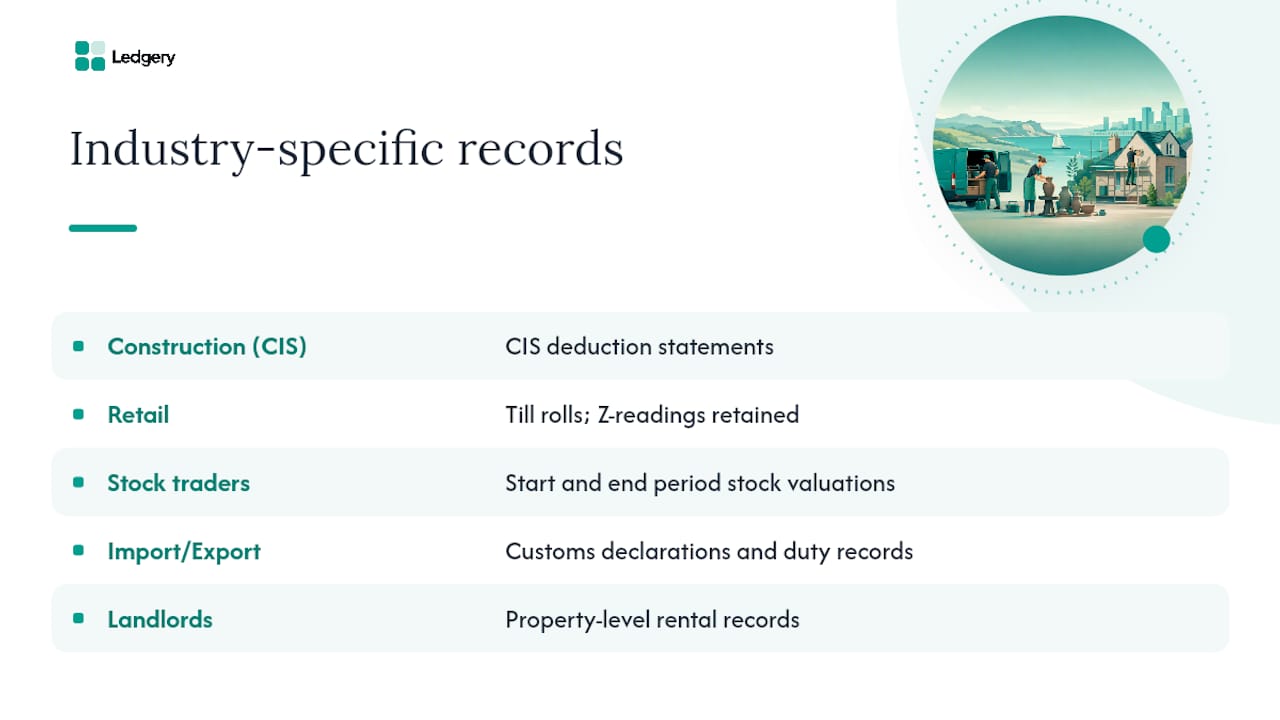
Landlords, as covered earlier, face a business-level standard despite property letting not always feeling like “running a business” in the traditional sense. The common thread across every sector is that HMRC wants documentation specific enough to justify each figure on the return, not generic proof that transactions happened. A landlord managing a single flat and a company running a fleet of delivery vans both need records detailed enough to withstand a line-by-line enquiry, even though the paperwork itself looks nothing alike.
How should you store records securely under data protection rules?
Tax records almost always contain personal data, whether that’s a sole trader’s own financial details or an employee’s payslip information, which brings UK data protection law into play alongside HMRC’s own requirements. Physical files should be kept somewhere with restricted access, a locked cabinet or a room not open to casual visitors, rather than left on a desk or in an unlocked drawer.
Digital storage needs a bit more thought. Password-protect any device or cloud folder holding financial records, and avoid syncing sensitive files to shared or public computers. If you use cloud storage, check where the data is actually held and whether the provider offers encryption both in transit and at rest, since a scanned invoice sitting unencrypted on a random server is a liability if that account is ever compromised.
Access matters as much as encryption. If you employ staff who help with bookkeeping, only give them access to the records they genuinely need, and remove that access when they leave. Keep a simple log of who can reach financial files and review it at least once a year. Destruction deserves the same care as storage: when a retention period finally ends, shred physical documents rather than binning them whole, and use a proper deletion method for digital files rather than simply moving them to a recycle bin that anyone could restore.
How do you hand over records to a new accountant or new owner?
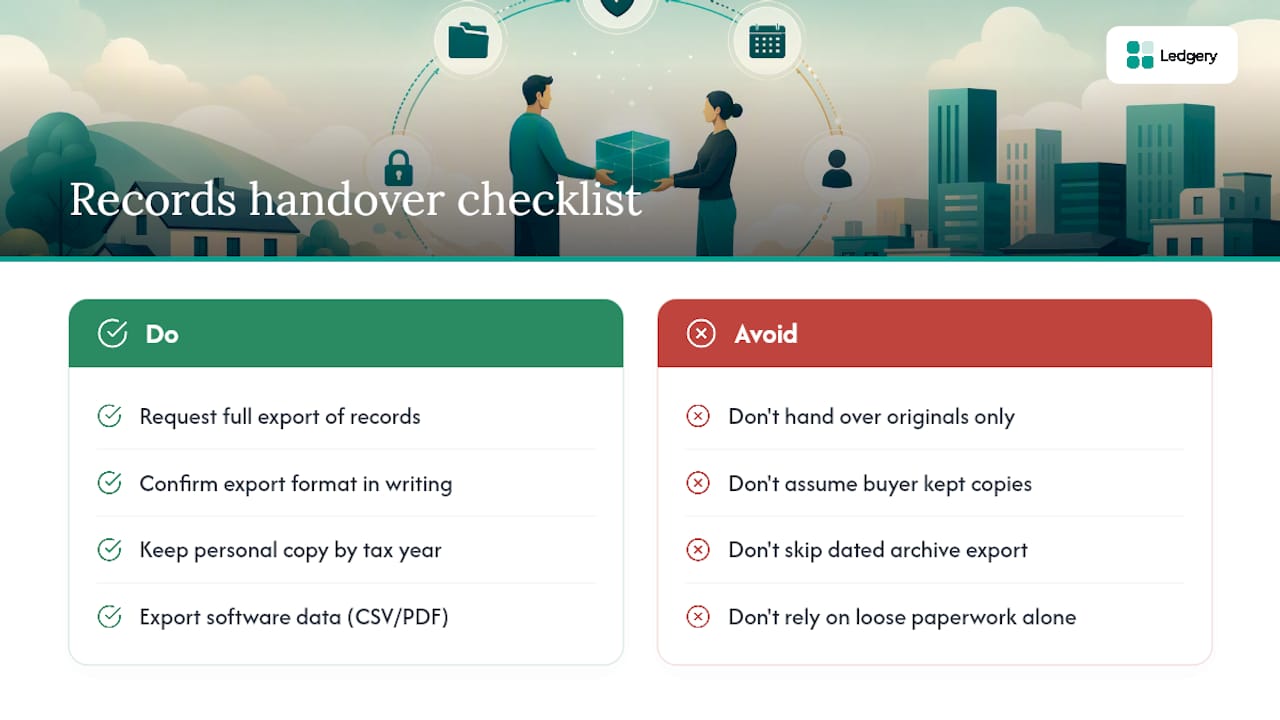
Changing accountants or selling a business creates a genuine risk that records go missing in the handover, right when continuity matters most. Before switching accountants, request a complete export of everything your current accountant holds, bookkeeping files, prior tax returns, correspondence with HMRC, and any working papers used to prepare past submissions. Get this in writing and confirm the format is something your next accountant can actually open and use.
Where a business is being sold or transferred, the seller typically retains ultimate responsibility for their own historic tax affairs even after ownership changes hands, so keep a personal copy of every record before handing originals over to a buyer. A clean way to do this is exporting everything to a dated archive, labelled by tax year, before the transfer completes, then providing the new owner or accountant with copies rather than your only set.
Agree explicitly on who holds what going forward. Ambiguity here is how records get lost, each party assuming the other kept a copy. If you use bookkeeping software, most platforms allow a straightforward data export in a common format like CSV or PDF, which makes the transfer far cleaner than a stack of loose paperwork.
What happens to your records when you stop trading or deregister for VAT?
Ceasing a business doesn’t shorten your retention obligations. The clock that started when you filed your last return, or when your last accounting period ended, keeps running exactly as it would if you were still trading. A sole trader who stops working in 2026 still needs records from their final tax year kept for 5 years from the following 31 January, precisely as if the business continued.
Deregistering for VAT works the same way. HMRC still expects the VAT records covering the period you were registered to be retained for the standard period, typically 6 years, even though you’re no longer submitting returns. This catches people out because there’s a natural instinct to clear everything out once the paperwork stops arriving, when the requirement to retain evidence hasn’t actually ended.
If you’re closing a company, the 6-year rule from the end of the final accounting period still applies, and company directors remain personally responsible for ensuring those records survive that period even after the company itself is dissolved. Keep a copy of final accounts, the last Corporation Tax return, and any correspondence confirming the company’s closure, since these often get requested if HMRC has any lingering query about the final trading period.
Why record-keeping habits matter more than the rules themselves
Most of the stress around HMRC compliance doesn’t come from the rules being complicated. It comes from record-keeping happening in a rush, months after the receipts and invoices are needed, when memory has already faded and paperwork has scattered. Regular, small capture habits, logging a receipt the day it lands rather than the week before a deadline, change the entire experience of filing.
Ledgery’s guidance on cash versus accruals accounting is worth reading precisely because the method you choose changes what “keeping a record” actually means in practice. Cash-basis traders need clean records of money received and paid; accruals-basis traders need invoice dates tracked separately from payment dates. For landlords, the property income allowance guide sets out where the detail genuinely matters versus where a simpler record suffices.
Automate the repetitive capture, photographing receipts, tagging expenses by category, but keep manual oversight over anything unusual, a one-off asset sale or a disputed invoice, because that’s where an enquiry is most likely to ask questions a spreadsheet can’t answer on its own.
— Jason
A simpler way to capture what HMRC expects
Ledgery scans your receipts and organises them into quarterly updates ready for HMRC submission, which matters most for anyone above the £50,000 threshold facing Making Tax Digital requirements from April 2026 onwards.

Building the retention habits covered above gets considerably easier when capture happens automatically at the point a receipt lands, rather than being reconstructed later from memory. This type of software can be built specifically for self-employed people and property owners, not limited companies or VAT-registered traders, so the reporting stays focused on the figures Self Assessment actually needs. Some services may offer a trial period to try workflows, quarterly updates and deadline alerts before committing to anything. If keeping organised, HMRC-ready records has felt like a recurring scramble, visit the Ledgery landing page and see whether the quarterly update workflow fits how you already work.
Where to check the official guidance
For the exact wording behind every period in this guide, consult HMRC directly: the self-employed record-keeping page, the individual pay and tax records page, the corporation tax manual (CH14600), and the penalties guidance (EM4650).
Recommended
Self-employment and property income in one subscription, first quarter free. Join the early access list and we’ll email you once, when it opens.
Join early access